

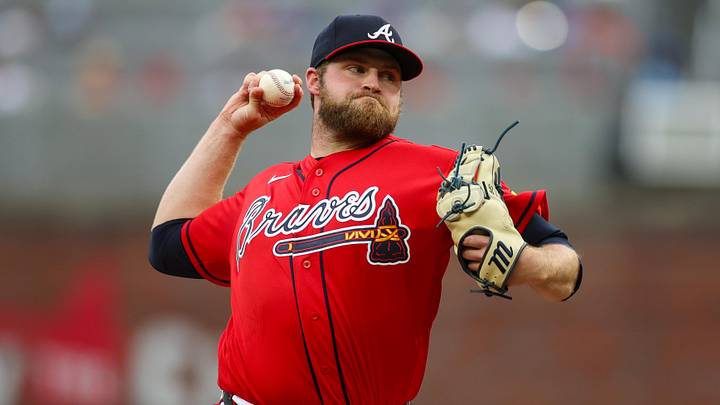
When injuries decimated the Braves’ pitching staff early in spring training, many wondered what the rotation would look like once the regular season began. Yet despite those concerns, Jeremy Hefner's staff entered Friday with the third-lowest ERA (3.10) and fifth-lowest xERA (3.60) among all Major League Baseball starting rotations.
Bryce Elder’s resurgence has been a major reason why. Entering the season, Elder was viewed as little more than solid depth — a pitcher Atlanta could stash in a mop-up bullpen role before injuries thrust him back into the rotation. To his credit, he has been exceptional, stepping up at a time when the Braves desperately needed stability from their starting staff.
But what exactly has transformed Elder into the reliable rotation arm the Braves so desperately needed? The answer is a turnaround few saw coming: the elite results he’s generating with his fastballs.
Bryce Elder, Painted 93mph Back Door Sinker. 🖌️🎨 pic.twitter.com/eEE5GCoaym
— Rob Friedman (@PitchingNinja) April 20, 2026
Bryce Elder's incredible turnaround with his varying fastballs has spurred his 2026 greatness
“Fastballs” is plural because Elder is finding success with multiple variations of the pitch. His traditional four-seamer, newly developed cutter, and patented sinker have all fueled one of the most remarkable pitching turnarounds in baseball this season.
Last season, Elder ranked in just the 12th percentile in Statcast’s Fastball Run Value. This year, he has skyrocketed to the top of the leaderboard, entering Friday night’s start in the 100th percentile in Fastball Run Value.
What makes the turnaround so remarkable is that the velocity and spin rates on Elder’s fastballs are not dramatically different from previous seasons. For years, his four-seam fastball had been a weakness, never posting a positive run value in any of his major league seasons from 2022-25. This season, however, Elder’s four-seamer has produced a +4 run value, according to Statcast.
Additionally, Elder’s sinker was one of the least effective pitches in baseball last season, finishing with a -7 run value. This year, it has undergone a complete transformation, as he’s weaponized the pitch to the tune of a +5 run value. The cherry on top is his newly developed cutter, which has already generated a +3 run value despite being used just 11.9% of the time.
For most of his career, Elder struggled just to get respectable production from his fastballs. Prior to 2026, his Fastball Run Value had not ranked higher than the 27th percentile since his rookie season. To go from those prolonged struggles to the elite results he’s producing now is a testament to the work Elder has put in behind the scenes.
Now, instead of merely trying to survive with his fastballs, Elder is winning with them. What was once a clear weakness has become a defining strength, reshaping his role in the Braves’ rotation and helping stabilize a staff that was in crisis just months ago. If this version of Bryce Elder holds, Atlanta may have found far more than a temporary fix — they may have rediscovered a dependable starter at exactly the right time.
 Add us as a preferred source on Google