

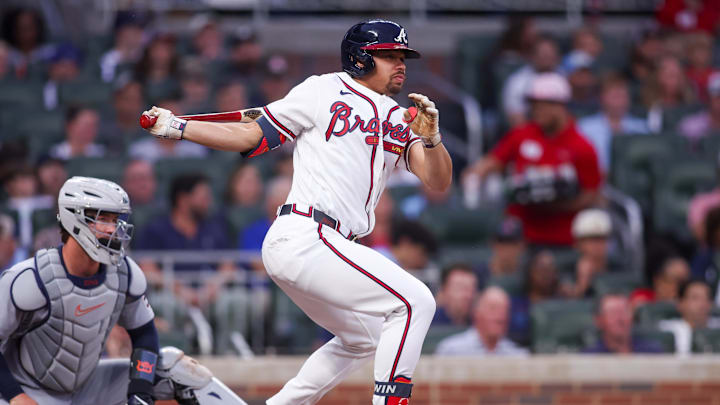
Coming off an incredible 2025 NL Rookie of the Year campaign, the baseball world wondered how Atlanta Braves catcher Drake Baldwin what the ceiling would be in his second season. ESPN's Buster Olney ranked him as the ninth-best catcher in baseball, which at the time, seemed like he was being slightly underrated.
However, through the first month-and-a-half of the season, it's become very clear that Drake Baldwin is one of the best catchers in baseball. With a stellar .889 OPS, 10 homers, and 32 RBIs, the second-year catcher has played a huge role in the Braves hot start.
What's being overlooked is exactly how he's managed to be so productive. As it turns out, he's been going to the plate with two very different approaches.
Drake Baldwin is two different hitters.
— Min Sub (Mitchell) (@MinSub4) May 13, 2026
With the bases empty, he's an all out power guy. He has a 25.4% K-rate, but has homered every 12.6 plate appearances. He's slashed .275/.351/.549.
He has a 75.1 MPH bat speed and a 24% whiff-rate. His xSLG is .713 with no one on.
With… pic.twitter.com/OlEOORstIw
Drake Baldwin's approach at the plate is very situational
For a player who ranks sixth in the league in RBIs and tied for 15th in home runs, it only seems natural that Drake Baldwin has picked up earned a fair amount of those runs batted in via the home run. However, that is simply not the case.
Nine of Baldwin's 10 home runs have been of the solo variety. The only non-solo shot of Baldwin's 2026 campaign so far came in Colorado, when Ronald Acuña Jr. stood on first base. This means that Baldwin does not have a single homer with a runner in scoring position.
Of course, Baldwin has 21 RBIs that have come without the need of a long ball. which indicates that he's still been highly productive with runners in scoring position.
The Braves catcher has come to the plate 49 times this season with a runner in scoring position, which is the 33rd most plate appearances in baseball. He's slashed .349/.429/.465. His batting average is 74 points higher with runners in scoring position than it is with the bases empty. However, his slugging is nearly 100 points lower.
Looking into the numbers, this is not an accident. When the bases are empty, Baldwin is much more willing to swing for the fences. His bat speed is 0.4 MPH faster and his whiff-rate is 25.3% with the bases empty, almost 10 points higher than it is with runners in scoring position.
However, once runners are on, Baldwin has been prioritizing not striking out. His strikeout rate is cut by more than half, dropping from 25.4% with no one on, to 12.2% with a runner standing on at least second.
While Baldwin's contact-oriented swing does lower his xSLG, dropping from .620 with the bases empty, to .396 with RISP, his xBA increases from .284 to .296. Essentially, Baldwin is making sure he gets the runners in, at the expense of the potential big bomb.
Baldwin has figured out a way to make himself both a power hitter on pace to hit over 30 homers, while also being a slap hitter when the situation calls for it.
 Add us as a preferred source on Google