

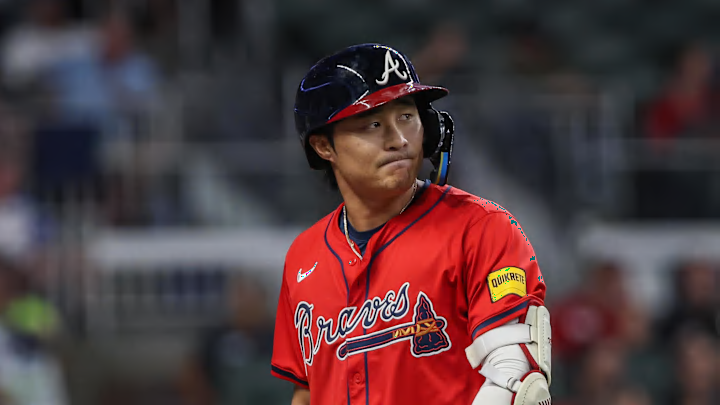
Sometimes even the most carefully considered offseason acquisitions fail to deliver the expected results. Just ask any Atlanta Braves fan about Jurickson Profar, and you’ll likely hear a quick acknowledgment of that reality. In other cases, a move made during the offseason ultimately proves unnecessary in hindsight.
This may be one of those instances for Braves general manager Alex Anthopoulos—an outcome that is less a reflection of poor judgment and more a product of circumstances beyond both his control and that of the player he signed.
The Braves re-signed shortstop Ha-Seong Kim in December 2025, believing they had finally secured a reliable, everyday option at the position—something the club had been searching for since the departure of Dansby Swanson. However, what Alex Anthopoulos and the front office could not have anticipated was that a starting-caliber shortstop may have already been on the roster, the result of a move made just one month earlier.
Mauricio Dubon's emergence makes us to ponder an alternate offseason without Ha-Seong Kim
Understandably, Anthopoulos had grown weary of the lackluster offensive production Atlanta had received from the shortstop position over the past two seasons. A reunion with Kim, therefore, was always on the offseason agenda.
What was far less predictable, however, was that another infielder would open the season as the club’s starting shortstop—necessitated by Kim’s offseason injury—and emerge as an integral contributor to Atlanta’s 8–5 start to the 2026 campaign. Yet, through the first few weeks of the regular season, that is precisely what has unfolded with Mauricio Dubón anchoring the position.
Dubón plates 2!#BravesCountry pic.twitter.com/f8zg7EqAgg
— Atlanta Braves (@Braves) April 8, 2026
Dubón has been nothing short of outstanding to begin the season, slashing .333/.362/.556 while posting a 157 wRC+. He also ranks second on the team in fWAR (0.6), trailing only Drake Baldwin. While it is unlikely that Dubón will sustain this level of production over the course of a full season, his early performance has demonstrated that Atlanta likely would have been well-served with him as its everyday shortstop, and allocating the $20 million committed to Kim elsewhere.
Of course, the rebuttal to that argument is that Atlanta’s rotation has been excellent early on, and much of Dubón’s value is tied to his positional versatility. Both points are valid. Still, it’s worth considering an alternative scenario—one in which the club wasn’t forced to rely on early-season starts from Martin Pérez or José Suárez within the first month of the year.
While it is still too early to label the move a misstep, there is a plausible scenario in which shortcomings in the Braves’ rotation prove costly in a tightly contested NL East race. The gap between Kim and Dubón appears far narrower than initially anticipated, and if the club falters elsewhere—particularly at the back end of the rotation—the decision to bring Kim back could invite legitimate scrutiny.
Ultimately, this situation underscores the delicate balance front offices must navigate when constructing a roster. Anthopoulos made a logical, defensible decision in bringing back Kim, addressing what had been a clear area of need. Yet, Dubón’s early emergence has complicated that narrative, highlighting how unforeseen cheaper options can sometimes render even well-reasoned moves redundant.
As the season progresses and upon Kim's return, the true impact of this decision will come into sharper focus. If Atlanta’s rotation holds steady, the added depth and flexibility may only strengthen the club’s position. However, if issues at the back end persist, the opportunity cost of that offseason investment will be difficult to ignore. In a division where margins are often razor-thin, even the most justifiable moves can ultimately be judged by how well they align with a team’s most pressing needs.
 Add us as a preferred source on Google