

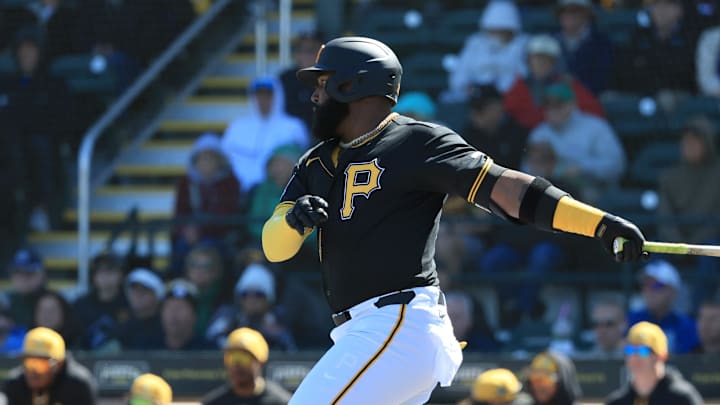
To the disappointment of Atlanta Braves fans, the Mets secured a decisive victory over the Pirates on Thursday afternoon. The outcome was not due to any shortcomings from Pittsburgh’s offense, which produced seven runs against Freddy Peralta and the pitching staff. Despite the game’s high-scoring nature, one former Brave delivered a notably quiet performance.
Marcell Ozuna turned in an 0-for-4 performance in Queens, highlighted by a pair of weak popouts and a strikeout. While it represents just a one-game sample, the early indications suggest Atlanta may have been prudent in allowing Ozuna to depart this offseason.
Marcell Ozuna's quiet spring an early sign the Braves were right to let him walk
When the Braves lost Jurickson Profar to his second suspension in as many seasons, questions surrounding where the Braves would pivot at DH began to flood in. By this time all of the sensible DH options had signed elsewhere in the offseason.
Initial reactions saw many fans express frustration that Ozuna had already signed with Pittsburgh. The void left by Profar at designated hitter prompted questions about how the lineup could take a step forward, particularly with Mike Yastrzemski and Ha-Seong Kim standing as the club’s most notable offseason additions.
While that question remains unanswered, it is becoming increasingly evident that Ozuna was unlikely to be the solution to the void Profar created at designated hitter. His production declined noticeably in 2025, and despite a full offseason to recover from a hip injury, his performance has yet to rebound. Over 46 spring plate appearances, Ozuna recorded a .646 OPS—below the mark Ozzie Albies posted in 2025, which itself represented a career low.
This presents a significant concern for a player like Ozuna, whose value is largely tied to his power production at the plate. The Pirates appear poised to deploy him as their primary DH, and with his signing effectively ushering fan favorite Andrew McCutchen out the door, the pressure on Ozuna to deliver will only intensify.
Ultimately, while it is still early, the most concerning aspect of Ozuna’s profile is the apparent decline in his power—once the defining trait of his game. From Atlanta’s perspective, the outlook at DH appears more flexible than it may have initially seemed. As Kim and Sean Murphy work their way back, the Braves should have more viable internal options to rotate through the DH spot, allowing them to prioritize matchups and maintain offensive balance.
That added versatility not only reduces the need to rely on a one-dimensional power bat, but also reinforces the notion that moving on from Ozuna could ultimately prove to be the more sustainable, forward-thinking decision.
 Add us as a preferred source on Google