

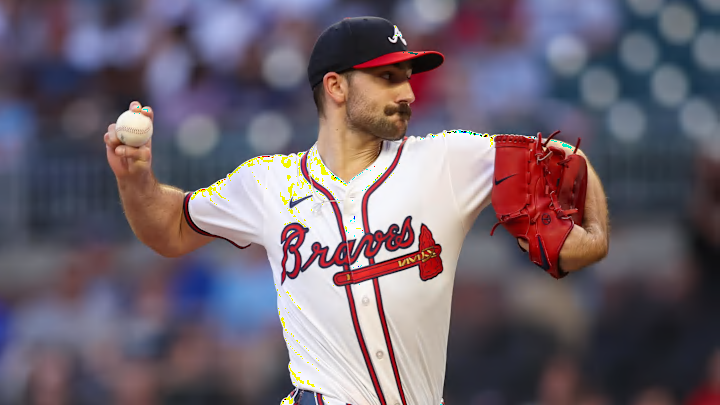
The primary focus in Atlanta Braves camp remains the starting rotation, and that is unlikely to change unless Alex Anthopoulos adds reinforcements. Questions surrounding Anthopoulos’ inability to secure another rotation piece have surfaced repeatedly, and given the current state of the Braves’ rotation, the concern is understandable.
Is Alex Anthopoulos placing too much confidence in the organization’s internal options, or did the offseason market simply fail to align with his valuation? Given Anthopoulos’ preference for operating discreetly, it is difficult to gauge the extent of his interest in pitchers such as Chris Bassitt who ended up signing with the Orioles much to the chagrin of many Braves fans. Still, the calls for a proven arm like Bassitt appear justified when considering the inherent risk attached to the current projected top four in the Braves' rotation.
Spencer Schwellenbach underwent surgery to remove loose bodies today. Hurston Waldrep will undergo a similar procedure on Monday. The Braves aren’t providing a timeline. Weiss said he hopes both will be able to pitch again this year
— Mark Bowman (@mlbbowman) February 18, 2026
Alex Anthopoulos' patient approach to the starter market may have cost the Braves
Chris Sale, Spencer Strider, Grant Holmes, and Reynaldo López each spent time on the 60-day injured list last season. As they enter 2026, fan confidence varies, but even the most optimistic supporters would struggle to feel certain that all four can navigate the grind of a 162-game schedule without further setbacks.
Injury risk is inherent in every rotation across Major League Baseball, but the Atlanta Braves increasingly resemble a case study in how quickly a pitching staff’s outlook can unravel. Hurston Waldrep is the latest arm to succumb to injury, further thinning Atlanta’s depth at the back end of the rotation, and it has created a sense that it’s Lucas Giolito or bust — hardly an ideal position for a club with legitimate postseason aspirations.
Anthopoulos has shown a willingness to act aggressively early in past offseasons, but the starting pitching market has been a different story. While patience can be justified, this time it may have cost the Atlanta Braves. With avenues to meaningfully upgrade the rotation now severely limited, every update surrounding the projected top four starters is being scrutinized closely.
Ultimately, the margin for error appears razor thin. Without an external addition to stabilize the rotation, the Atlanta Braves are placing significant faith in health and internal depth — two variables that have already proven volatile. For a club with postseason expectations, that gamble could either validate the front office’s restraint or magnify what will be viewed as a missed opportunity.
 Add us as a preferred source on Google