

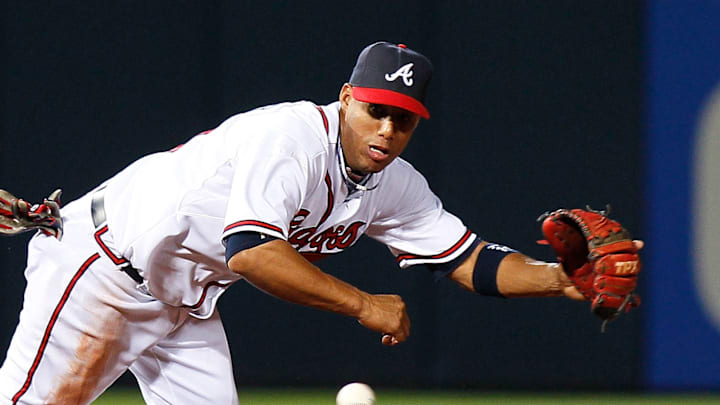
When Yunel Escobar signed with the Atlanta Braves on June 7, 2005, it was the culmination of a dream he’d shared with his best friend Brayan Peña since they were 13. Peña defected from Cuba in 1999 and signed with the Braves in November 2000, but his defection meant that his best friend was still in Cuba looking for a way out
Yunel lost his best friend and gained the company of security guards who seemingly shadowed him everywhere for two straight years.
The Braves lost a premium talent in Yunel Escobar to tradition
Escobar finally made his escape in 2004, and after 14 days in a small, wooden boat with a dozen others, trying to stay out of sight of the Coast Guard, before landing in Florida in October. It was too late in the year for Escobar to play in games, and he managed to arrange only a dozen workouts with scouts present. Legendary Braves’ scout Roy Clark liked what he saw and spent hours essentially interrogating Peña about Escobar’s ability. Based on Peña’s recommendation, the Braves took Escobar in the second round of the 2005 draft, 75th overall.
Finally, an Atlanta Brave
Appalachian League pitching was no match for Escobar’s experience with the Cuban under-17 team. He played only eight games in the Appy League before being bumped to Rome in the Sally League, where he batted .313/.358/.470/.828 in 214 PA. His power numbers dropped in Mississippi the following season, but his biggest problem was that he and manager Jeff Blauser didn’t get along.
Escobar returned to his earlier form in the Arizona Fall League in 2006, and the Braves felt his work there meant he was ready for AAA. He was batting .333/.379/.456/.835 for Richmond when he got the call to Atlanta. Convinced by his early performance that Escobar was the shortstop of the future, they included Elvis Andrus in the deadline trade for Mark Teixeira, and sent Escobar’s mentor Edgar Renteria to Detroit in October.
The Braves' rookie shortstop batted .385/.451/.837 with a 118 OPS+ and finished sixth in NL Rookie of the Year voting.
A Star Becomes a Problem
From 2007 through 2009, Escobar was a 10.1 bWAR, 9.0 fWAR player who walked almost as often as he struck out (143 vs. 168), got on base at a .375 clip, and slugged .425, but it wasn’t always smooth sailing. Escobar was a talented player who loved the game and played baseball with the flair, joy, and smile of today’s typical Latin American player. He flipped his bat, whistled while on the field, and clapped his hands a lot, none of which set well with a Bobby Cox team that saw things like that as not playing the game the “right way.” Does any of that sound familiar?
Fans criticized him for his lack of hustle and level of commitment while voting him as the winner of the club’s Heart and Hustle Award. But Alex Anthopoulos liked him enough to trade Álex González to take Escobar’s place at short with the Braves, along with Tim Collins and Tyler Pastornicky, for Escobar and Jo-Jo Reyes.
Over the next three seasons (2011-2013), he posted 7.9 fWAR between Toronto and Tampa. He struggled with Tampa in 2014, but bounced back to post 2.3fWAR for the Nationals in 2015. He retired after spending 2017 with the Angels.
That’s a Wrap
Yunel Escobar risked his life to come to this country and play for the Braves, but baseball was just learning that there’s more than one way to play the game. Had he arrived in 2017, his career would almost certainly have been happier.
 Add us as a preferred source on Google