

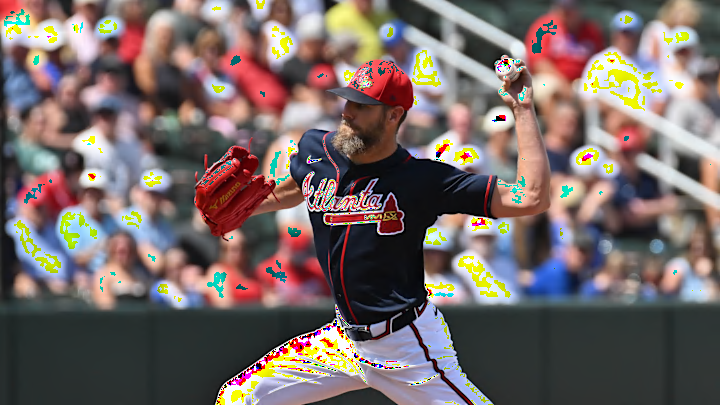
The Atlanta Braves’ projected rotation features a diverse mix of experience and potential. Veteran ace Chris Sale is expected to anchor the staff, while Spencer Strider aims to rebound with a strong return to form. Reynaldo López and Grant Holmes will look to demonstrate that their injury concerns are behind them, and Bryce Elder faces increasing pressure to secure his spot amid competition from emerging prospects.
Each of these pitchers offers a distinct set of strengths and weaknesses. In projecting their 2026 seasons, one useful exercise is to evaluate and rank their most impactful traits, providing a clearer picture of the strengths and limitations that define each arm. Of note, we don't have Didier Fuentes under consideration here as he is being listed as a reliever for the moment. Until we see him getting starts regularly, he just doesn't belong in this discussion yet.
Ranking the Braves' rotation by their best tools
Which Braves pitcher has the best individual pitch?
Let’s begin with a relatively straightforward choice. When evaluating which member of the rotation possesses the premier pitch, there is little room for debate. Sale’s slider stands not only as the best pitch on the staff, but arguably the most dominant in all of baseball. The data supports that claim: his slider produced a run value of 23 last season, second only to Tarik Skubal’s changeup (25 run value) for the highest mark among individual pitches.
Chris Sale doing Chris Sale things... pic.twitter.com/qYU9FB7KvO
— Rob Friedman (@PitchingNinja) February 22, 2026
Which Braves pitcher has the best command?
In modern baseball, there is a well-placed emphasis on a pitcher’s velocity and Stuff+ metrics. However, that does not mean command has been devalued. When evaluating command, FanGraphs provides a valuable metric in Location+, which helps quantify how effectively pitchers are able to consistently hit their intended spots.
When examining last season’s Location+ leaders, a somewhat surprising name tops the leaderboard for Atlanta. Bryce Elder led all qualified Braves pitchers in 2025 with a 108 Location+ score, while Sale followed closely with 105. Over the course of their careers, Sale maintains the team lead in Location+, whereas Elder, Reynaldo López, and Grant Holmes generally hover around league-average command.
Can Strider or Lopez regain their dominance with the fastball?
When evaluating the rotation’s fastballs, it’s clear that few pitchers will consistently overpower hitters with sheer velocity. Sale is known for reserving his top-end fastballs for high-leverage situations, while López and Strider must adjust to life without the 99 mph heaters that once defined their repertoires.
Last season, Strider’s fastball posted a -6 run value, a stark contrast to his dominant 2023 performance, and Lopez's dip in velocity was a major headline in spring of 2025. This year, early spring appearances suggested that neither Strider nor López would regain their previous velocity, leaving fans to hope that improvements in induced vertical break (IVB) metrics are sufficient to consistently retire major-league hitters.
Will Grant Holmes add tools to support his dominant slider?
The final rotation member to examine is right-hander Holmes. The long-haired righty has shown that his slider can be a dominant weapon when healthy and on the mound. Holmes’ struggles in 2025 largely stemmed from a hittable fastball, and this spring it appears he is focused on expanding his arsenal to strengthen that pitch. Last season, his fastball ranked in just the eighth percentile in run value, making improvements a clear priority for the upcoming campaign.
This spring, Holmes has been experimenting with a sinker, a pitch designed to give hitters a different look compared to his traditional four-seamer and cutter. If he can command a fastball with distinct east-west movement, Braves fans could see meaningful gains from Holmes, building on the solid 3.99 ERA he posted last season.
Overall, the Braves’ projected 2026 rotation combines high-end talent, promising upside, and intriguing developmental stories. From Sale’s elite slider to the evolving arsenals of Spencer Strider, Reynaldo López, and Grant Holmes, each pitcher brings a unique profile of strengths and areas for growth.
With improvements in command and pitch mix, Atlanta’s rotation has the potential to provide the depth and versatility needed to navigate a long, grueling season. For Braves fans, the 2026 rotation offers both excitement and optimism, with the hope that each pitcher can also maintain the health necessary to perform at a high level throughout the full campaign.
 Add us as a preferred source on Google