

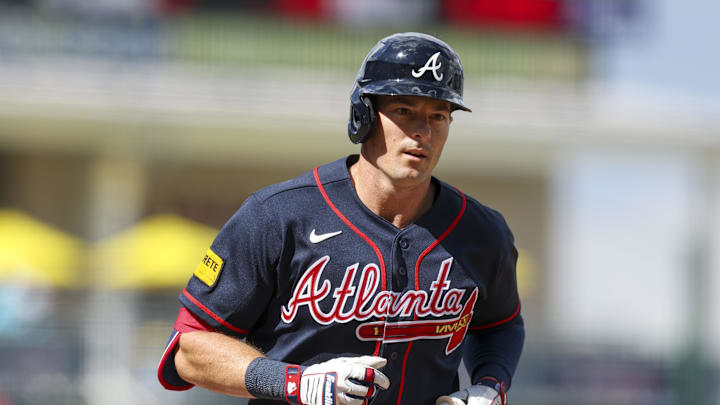
The Atlanta Braves have been generating offense in waves of late, a testament to the depth and balance of their lineup. In Friday night’s 11-run outburst against the Guardians, every player in the starting lineup recorded a hit except for one: Mike Yastrzemski.
Unfortunately, that has been a recurring theme early in the 2026 season for the Braves’ left fielder. Yastrzemski enjoyed an outstanding spring training, but like Austin Riley, that success has yet to carry over into the regular season. While it is still early, a concerning trend in Yastrzemski’s profile is beginning to emerge—one that will be worth monitoring as he looks to break out of his slump.
When the Braves signed Mike Yastrzemski in December, it quickly became clear why the move could prove astute for Alex Anthopoulos. Throughout his career, Yastrzemski has excelled in two key areas: producing against right-handed pitching (120 career wRC+ vs. righties) and pulling the ball in the air (23.9% career pull air rate). This season, however, the latter has dropped to a career low.
Mike Yastrzemski goes YARD 💪 pic.twitter.com/fWUvft9RSV
— MLB (@MLB) February 27, 2026
Mike Yastrzemski's career-low pull air rate is something to monitor for Braves fans
The logic behind the Yastrzemski signing was clear—his career strengths appeared well-suited to flourish in a more hitter-friendly environment than he had previously experienced. The expectation was that plenty of balls would find their way into the Chop House at Truist Park. So far, however, that anticipated power surge has yet to materialize.
As noted earlier, Yastrzemski’s career pull air rate sits at 23.9%. As of Saturday, that figure has dropped to a career-low 10.3%. Given that he has consistently posted a good-to-elite pull air rate throughout his career, this dip is somewhat concerning. The early-season, small-sample-size caveat certainly applies, but if the Braves hope to get Yastrzemski going, elevating and pulling the baseball would be a logical place to start.
When examining his other batted-ball metrics, the sharp decline in pull air rate has largely translated into a spike in ground balls. Yastrzemski owns a career 35% ground-ball rate, but that figure has climbed to a career-high 48.3% this season. Naturally, the inverse has also followed, with his launch angle dropping to a career-low 12.3°.
If there is a silver lining, it’s that the underlying issue appears to be more mechanical than physical, as his bat speed is the exact same as last season. Yastrzemski’s track record suggests he knows how to produce damage by getting the ball in the air to his pull side, and a return to that approach could quickly change his mild results at the plate thus far.
Fortunately for Atlanta, the team continues to win at a high clip, fueled by the depth of its lineup and an unexpectedly strong start from the rotation. There remains ample time for Yastrzemski—and a few others—to find their rhythm at the plate. For now, the struggles are worth monitoring, but it is far too early to draw firm conclusions. If he can begin to lift and turn on pitches with greater consistency, the results—and the power the Braves envisioned—should follow.
 Add us as a preferred source on Google