

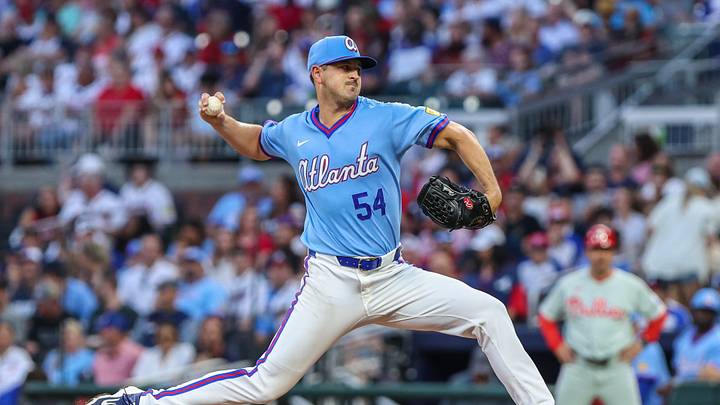
Coming into the offseason, the one of the most glaring needs for the Atlanta Braves was adding starting pitching outside of Chris Sale. Although it took nearly a month in what is certain to be a condensed offseason, the Braves finally made a move by reuniting with Tyler Mahle, who dominated with Atlanta after being acquired at the trade deadline.
Still, even after dedicating $40 million to the rotation, the Braves should not rest quite yet when it comes to their pitching.
Tyler Mahle's re-signing isn't enough for the Braves
Outside of Chris Sale and now Tyler Mahle, the final three spots in the rotation are big question marks. While Didier Fuentes will get a shot at the rotation after a dominant rookie year out of the bullpen, the Braves have already stated they won't commit to the youngest as a starter unless he looks like a middle- to front-of-the-line arm.
Grant Holmes and Bryce Elder both lobbed a lot of innings for the Braves, but both have worrying underlying metrics that indicate they are likely low floor, low ceiling type of starters. Spencer Strider and Spencer Schwellenbach have some of the highest ceilings in baseball among starting pitchers when healthy, but neither have been able to stay healthy, and the Braves are clearly not expecting to rely on the duo going into spring training.
While Mahle's signing was absolutely necessary, and while the Braves still have plenty of hypothetical arms in Fuentes, Holmes, Elder, Schwellenbach, and Strider, the majority of the their rotation isn't set in stone.
Considering their rival Phillies have one of the best rotations in baseball, and their other rivals, the New York Mets just spent $450 million on a single pitcher, it's arguable that the staff, as currently constructed, lags behind these two teams.
Mahle is a great starting point for the offseason, but realistically, if the Braves want to compete with the Mets and Phillies in 2027, they'll need to add one more arm along the lines of a Michael Soroka or a Michael King.
 Add us as a preferred source on Google