

Going into the 2025-2026 offseason, there's no doubt that one of the Atlanta Braves priorities is strengthening their starting rotation. Even with a stellar front of the rotation in Chris Sale and Spencer Schwellenbach, and former All-Stars Spencer Strider and Reynaldo Lopez offering a high ceiling, 2025 showed that you can never have too much depth.
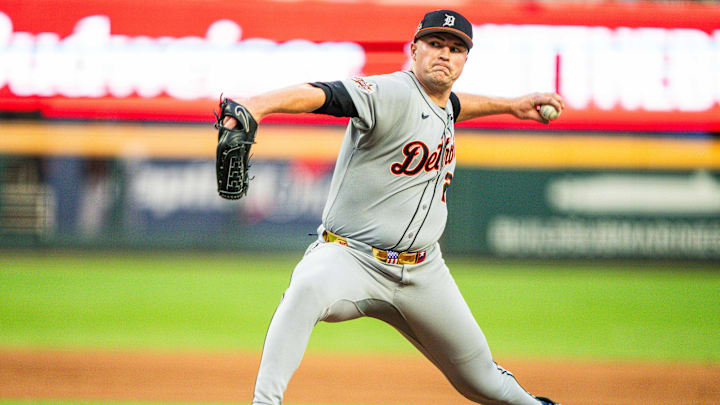
While the free agent class offers plenty of talent, the most prized starting pitcher available might be the Detroit Tigers ace Tarik Skubal. If Skubal is indeed on the market, the Braves should do everything they can to land the lefty ace.
Of course, the 2024 (and likely 2025) AL Cy Young winner won't come cheap. This is what it would likely cost the Braves to get Skubal.
Building a hypothetical trade package to bring Tarik Skubal to the Braves
Cy Young caliber pitchers are seldom available. In fact, it's been 13 years since the last time a reigning Cy Young winner was traded. Coincidentally, the last GM to acquire a reigning Cy Young winner was current Braves general manager Alex Anthopolous.
R.A. Dickey and Tarik Skubal are very different pitchers at very different stages in their career, but getting Dickey to Toronto still cost the Blue Jays John Buck, Travis d'Arnaud (MLB's 11th-best prospect at the time), Noah Syndergaard (the Blue Jays' third-best prospect), and Wuilmer Becerra, d'Arnaud and Syndergaard would play big roles for the Mets for several seasons afterward.
Skubal will likely be just as expensive, if not even more costly than Dickey was in 2012. The Braves only have two prospects in MLB Pipeline's top-100, and their best prospect, Cam Caminiti, ranks 72nd on MLB Pipeline and is nowhere near MLB-ready like d'Arnaud was heading into the 2013 season.
Simply put, prospects alone will not get the job done.
Thankfully, the latest blockbuster around a superstar heading into free agency could serve as a model for the Braves. When the Astros traded Kyle Tucker to the Chicago Cubs, the only prospect they acquired was the 73rd best-prospect in baseball, Cam Smith.
To make up for the talent gap, the Cubs traded swingman Hayden Wesneski, and pull-artist Isaac Paredes, who's mastery of pulling the ball did not work well in the Windy City but was engineered for Houston.
The Tigers are in a similar position to the Astros. Detroit doesn't need prospects, especially prospects that are years away. What they really need young talent that is ready now.
The most painful but necessary piece of a potential Skubal-to-Atlanta trade would be Michael Harris II. While Harris's 2025 was certainly disappointing, the 24-year-old showed off his ceiling during the summer, where he had a 130 wRC+ in the second half.
Harris's contract, admittedly, isn't a great mirror to Paredes. While Paredes had three years of team contract, Michael Harris II still has at least five years of what should be a team friendly deal thanks to the extension he signed as a rookie.
In a way, Harris's extra years could be appealing for the Tigers, but as 2025 showed, extensions don't come without risks. If Harris's 2025 is more indicative of his play going forward, the Tigers would be left on the hook for a below-average outfielder.
Still, with the inclusion of Harris in the package, the Braves likely would not need to part with either Caminiti or JR Ritchie, the club's other top 100 prospect. Instead, letting the Tigers choose two pitchers out of a group of Hayden Harris, Jhancarlos Lara, Dylan Dodd, Bryce Elder, and Rolddy Muñoz, as well as another prospect not on the 40-man roster who is approaching MLB readiness, like Ian Mejia.
While this would certainly be an expensive package for a star on the verge of free agency, history shows that winning teams willing to part with top-tier talent demand a king's ransom. It's up to the Braves to decide if it's worth it or not.
 Add us as a preferred source on Google