

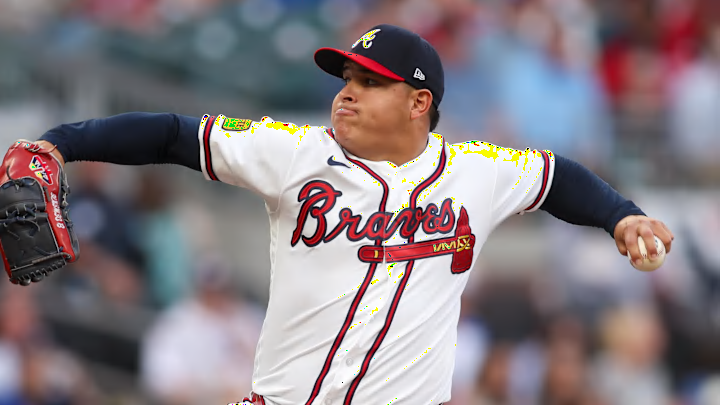
Following the disastrous start to the 2025 season, few Atlanta Braves fans would take issue with a 4–2 opening this year. Drake Baldwin has been a standout performer, and the pitching staff has largely held steady through the first two series. However, as Atlanta prepares for its first road trip of the season, a significant concern remains: the lack of stability at the back end of the rotation continues to pose challenges.
The Braves initially opted to fill the final rotation spot with José Suárez, but his outing against the Athletics made it evident he is unlikely to be a sustainable option moving forward. Veteran Martín Pérez followed Suárez in a piggyback role on Tuesday and proved far more effective, making it reasonable to project him as the leading candidate to take over that spot the next time through the rotation.
Atlanta’s short-term approach to the final rotation spot is serviceable, but once Didier Fuentes is ready, the organization’s path forward becomes clear. Any prolonged hesitation in making that transition risks dropping games that could ultimately prove costly as the season unfolds.
Braves have to put Didier Fuentes into the rotation as soon as he is stretched out
The Braves optioned Didier Fuentes on Sunday with the stated goal of “stretching him out,” a decision that was met with some frustration from Braves fans. While Fuentes was not flawless in his four-inning relief appearance, he undeniably offers greater upside than either Suárez or Pérez. By the time he becomes eligible to return, Atlanta should have a clearer sense of which of those two veterans is more expendable.
Of course, the eventual return of Spencer Strider could also factor into the equation, though the Braves certainly won’t view an abundance of starting pitching as a problem. In fact, if both Suárez and Pérez fail to prove valuable in long relief roles, it would not be surprising to see Atlanta also turn to another top pitching prospect, JR Ritchie, for additional depth.
Ultimately, how the Braves handle the back end of their rotation in the coming weeks could have a meaningful impact on their early-season trajectory. While the current approach may suffice in the short term, the organization’s long-term success will hinge on its willingness to prioritize upside and make decisive adjustments when the opportunity arises.
With reinforcements like Fuentes—and eventually Strider—on the horizon, Atlanta has the pieces in place to solidify its pitching staff, but capitalizing on that potential will require a sense of urgency—one the front office has yet to fully demonstrate.
 Add us as a preferred source on Google