

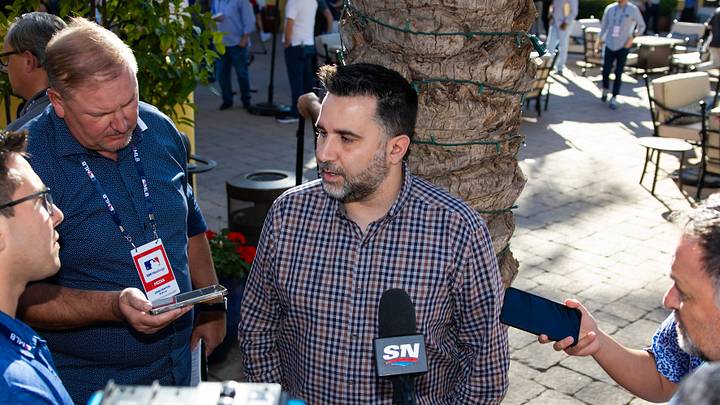
While the vibes around the Atlanta Braves are very low at the moment (and with good reason), it is easy to forget that Alex Anthopoulos has done a lot of good for the franchise since taking over. His work at the 2021 trade deadline is pretty much the only reason that the Braves were able to complete their World Series run. He has rewarded younger players (as well as fans) with extensions that most observers lauded at the time, and even some of his bargain-basement additions turned into valuable contributors (we remember you, Tyler Matzek). However, one blind spot he has had is with adding starting pitching from outside the organization, and that is a problem.
It isn't as though Anthopoulos isn't aware that the Braves need starting pitching. Just earlier this year, he declared that need before the latest wave of rotation injuries and heavily implied that he was looking to strike early and aggressively on the trade market to address it.
The problem is that, for all of his gifts, insights, and accomplishments, Anthopoulos and his front office are valuing starting pitching additions in a way that prices the Braves out of most quality free agents and trade targets before talks even get started.
Alex Anthopoulos clearly thinks starting pitchers are overvalued in trades and free agency, but he doesn't decide the market
Anthopoulos' tendencies with rotation arms are pretty well established at this point. As we previously saw with Cole Hamels (yuck), Dallas Keuchel, and some others, he is willing to sign starters, but he has a very strong preference to only sign them to short-term deals. That may make sense given the risks that come with pitchers, but that preference automatically eliminates probably 80% of the free agent pool. Sure, pitching may seem expensive, and Anthopoulos may not want to pay more than he has to, but the market is the market. Every team needs at least five starters, and most of them are willing to roll the dice on deals that are longer than a couple of years.
That alone has put the Braves behind. Anthopoulos hasn't signed a rotation arm to a deal of consequence since taking the job. The trade market has yielded a bit more success, with Chris Sale being the obvious success story, but that has been the exception to the rule. Atlanta took advantage of Sale's injury history and Boston's financial situation to get the deal done and then, frankly, got a bit lucky that it worked out.
However, even the trade market has exposed a similar problem. When Anthopoulos talks about his trade ambitions, he often talks about adding arms that will help the Braves now as well as in the future. Translation: he wants to trade for arms with team control, which, again, makes sense in a vacuum, but baseball doesn't operate in a vacuum. The price tag for those types of arms is very high, and Anthopoulos simply won't pay it. To put it another way, when in the last decade or so has Anthopoulos made a significant trade for an established starting pitcher with team control outside of Sale?
Anthopoulos is good at a lot of things. Matt Olson would not be a Brave without him. He struck the trade deadline trade for Raisel Iglesias at the buzzer, and that worked out great. His front office drafted Drake Baldwin, Michael Harris II, and now Eric Hartman. However, he is trying to play by market rules and expectations when it comes to rotation arms that pretty much no other team in baseball is right now, outside of the teams that won't spend on anyone for any reason.
The end result time and time again has been that the Braves have had very questionable pitching depth that leans heavily on unproven young players. That has worked sometimes, but we are seeing what happens when the tightrope act Atlanta has been performing doesn't work out right now. If the Braves want to stay competitive, they need to accept that they don't get to declare what the market and price for starters should be.
 Add us as a preferred source on Google