

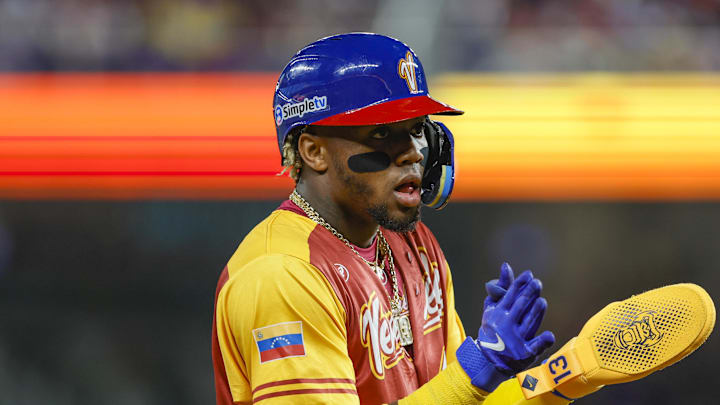
The international free agent market in Major League Baseball can be opaque and unpredictable. Atlanta Braves fans understand this reality well following the controversy involving former general manager John Coppolella. At times, these signings yield tremendous value for an organization; in other cases, even the most highly touted prospects fail to develop into major league contributors.
Major League Baseball prohibits teams from officially signing international free agents under the age of 16. However, those who closely follow the market understand that clubs often reach informal “handshake” understandings with prospects from future signing classes. While such reports should always be treated cautiously, it has been reported that the Braves have reached a significant informal arrangement with a future IFA prospect—who also happens to be the cousin of Ronald Acuña Jr.
BREAKING: Carlos Blanco has reached a pre-agreement with the Atlanta Braves for a $1.5 million signing bonus 💰
— Wilber Sánchez (@wilberdata) February 9, 2026
Blanco is considered the best defensive shortstop in the 2030 international class, featuring a strong arm, soft hands, and advanced feel for the game. Evaluators… pic.twitter.com/SXNddapjc9
Braves have reported pre-agreement with future IFA prospect Carlos Blanco
The Braves tend to lean towards position players in their IFA classes, and Carlos Blanco, the cousin of Braves superstar Ronald Acuña Jr., is widely regarded as a potential top position player talent in the 2030 international free agent class. His advanced feel for the game, defensive ability, and familial connection to Acuña make him a logical target for Atlanta. However, the reported $1.5 million informal “pre-agreement,” as noted by Wilber Sánchez, raises understandable questions.
Targeting IFAs with familial ties to Acuña is not inherently misguided, but committing significant resources to a 12-year-old prospect introduces considerable risk. This is especially true for Atlanta, an organization aware of how penalties tied to international signing violations can severely disrupt the trajectory of a farm system.
The international free agent market is notoriously difficult to project, even with elite scouting. In many cases, prospects who sign for modest bonuses go on to become top prospects within an organization. Atlanta’s philosophy of swinging big is not uncommon across the league, but in recent years it has felt as though the club may have been better served by spreading its resources more broadly—throwing more darts at the board rather than attempting to hit a bullseye with a limited number of high-stakes investments.
Ultimately, the reported interest in Blanco underscores both the upside and the inherent risk of operating in the international free agent market. Blanco may well develop into a premium talent, and his connection to Acuña Jr. only adds to the intrigue. Still, history has shown that early bets on ultra-young prospects are far from guarantees—especially for an organization that has already felt the consequences of pushing the boundaries in this space. For the Braves, the challenge moving forward will be balancing bold ambition with disciplined restraint, ensuring that long-term upside does not come at the expense of organizational stability.
 Add us as a preferred source on Google