

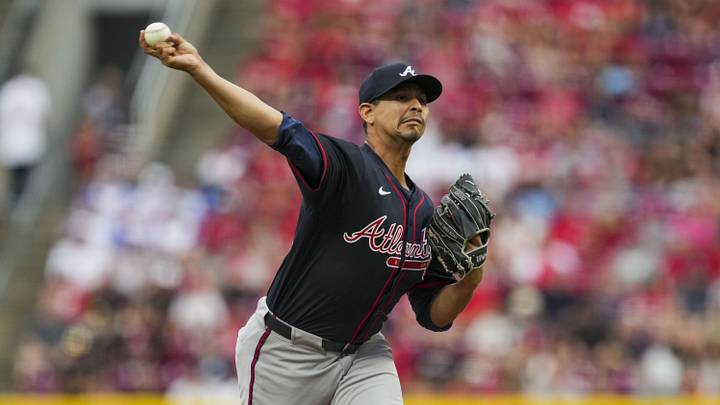
After back-and-forth battle between the Atlanta Braves and the San Diego Padres finally looked to be in a position that favored the Braves in the late innings. After all, going into the seventh inning, their big guns of Dylan Lee, Robert Suarez, and Raisel Iglesias had all had plenty of rest.
But instead of going to one of their late inning relievers for the seventh inning, manager Walt Weiss made the baffling decision to send Carlos Carrasco out for a second inning, and it immediately backfired.
Baffling Braves bullpen decision against Padres still doesn't make sense
Turning to Carrasco for the sixth inning after J.R. Ritchie battled to complete five wasn't ideal in the first place, but at least made sense, even before knowing that Robert Suarez wasn't available. Carrasco is the last man in the Braves bullpen, and his cyclical DFA is becoming comical at this point.
Didier Fuentes, who has quickly become the Braves de facto sixth inning guy had been used briefly the day before, and had thrown 28 pitches on Saturday. James Karinchak, who has quickly gained trust in the Braves bullpen since getting the call up in early June, had thrown 22 pitches the day before. Dylan Dodd threw 39 pitches on Monday.
Considering where these arms stood, it initially made sense to use Carrasco in the sixth since he was not only the freshest arm, but he was also facing the bottom of the lineup against one of the worst offenses in baseball. To Carrasco's credit he got a 1-2-3 inning out of it.
It's the decision to bring him back out for the seventh that deserves to be scrutinized. Even after finding out Suarez has been dealing with some arm soreness, it's clear Weiss could have approached the flow chart differently.
The first option, Didier Fuentes, could have certainly covered a full inning. Although he had pitched Monday, he only threw four pitches and faced one batter. Even if the 28 pitches from Saturday are within the calculations, it's still one of just two games he had appeared in over the last 10 days.
Of course, because of Fuentes's youth, it might be understandable to give the 21-year-old, who has never pitched more than 75.2 innings in a season an extra day of rest. But with an off-day on Thursday, the Braves could have given him two days of rest after Tuesday night.
The second option, James Karinchak did throw in the bullpen on Tuesday, which indicates he was not fully off the table as an option. Perhaps Weiss hoped to stay away from a potential full inning after using him for 1.2 innings the night before, but if he was warming up, then it means the Braves were open to the potential he may have to face three batters.
The third, albeit less desirable option would simply be to use Dylan Lee and Raisel Iglesias to cover the seventh and eighth. Because of the decision to send Carrasco out for the seventh, both Lee and Iglesias wound up finishing one inning and starting the next in less ideal situations than they would have.
Considering that both had plenty of rest and the Thursday off-day, as well as being generally efficient pitchers, there's no doubt that the two could have divvied up three innings. Lee and Iglesias had pitched in a combined three games over the previous ten days.
Instead, Carrasco immediately allowed the game-tying home run to a power-starved Fernando Tatis Jr., the Braves offense failed to retake the lead, and their mid-June swoon continued, leaving Braves fans across the country scratching their heads.
 Add us as a preferred source on Google