

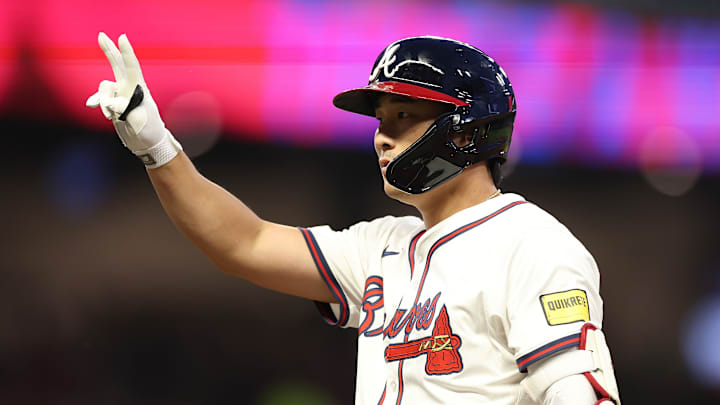
Alex Anthopoulos didn’t have to spell it out, but he basically did. When the Braves’ president of baseball operations admitted that starting pitching and shortstop are the two spots his front office is “spending the most time on right now,” he was quietly circling the exact fault line that shifted their winter. Ha-Seong Kim’s opt-out didn’t just take a name off the depth chart; it blew up the most convenient answer to one of Atlanta’s two biggest questions and shoved the organization into a far more expensive marketplace than it had planned on swimming in.
Kim wasn’t a luxury for Atlanta — he was baked into the plan. After acquiring him late in 2025, the Braves expected his $16 million player option to bridge them into 2026, finally giving them steady, above-average defense at a position that’s been a revolving door. Given the thin shortstop market, his decision to opt out wasn’t exactly a surprise, but it still took away a reliable, fairly priced solution the front office appeared to be counting on. With Kim back on the open market, the Braves are essentially reset at shortstop and forced to reassess how they spread their offseason budget around.
Ha-Seong Kim’s opt-out forced Braves to rewrite their offseason plan
Kim’s decision instantly reopened a crater at shortstop and shoved Atlanta into the same aisle as every other contender desperate for stability up the middle. Now, instead of treating shortstop as a solved problem and spreading resources around the roster, Anthopoulos has to operate as if he’s shopping for a centerpiece: a high-end infielder who can both anchor the defense and lengthen a lineup that sagged at that spot in 2025. That’s why, almost overnight, the Braves are being mentioned next to names like Kim (again), Bo Bichette, and any other shortstop-adjacent upgrade that might shake loose via trade.
Once you see it through that lens, a lot of the Braves’ early-winter choices start to line up with Anthopoulos’ own words.
When Mark Bowman of MLB.com asked where the front office is devoting its energy, Anthopoulos didn’t dress it up: most of their time right now is going into starting pitching and shortstop, not rebuilding the bullpen. That tracks with the decision to decline options on Pierce Johnson and Tyler Kinley, let Raisel Iglesias hit free agency, and live with the uncertainty around Joe Jiménez’s post-surgery timeline until closer to spring. On paper, it leaves the relief corps looking thin. In practice, it hints at a front office that’s deliberately pushing bullpen decisions to the back burner so it can address bigger-ticket items first.
Viewed that way, the approach feels less like corner-cutting and more like triage. Anthopoulos knows he can usually find relievers later, but he doesn’t get the same luxury at shortstop or the front of the rotation. Impact infielders and frontline arms tend to come off the board early and cost real money. If there’s anywhere you can afford to be light in November while you chase those pieces, it’s the pen.
So Kim’s opt-out ends up being more than a footnote in his transaction log; it’s the pivot point for Atlanta’s entire winter. It explains why the Braves sound comfortable living with an unfinished bullpen in November. It explains why they’re suddenly tied to every impact infielder and starter expected to move. And it underscores just how much pressure now sits on Anthopoulos’ desk.
 Add us as a preferred source on Google