

The Atlanta Braves aren’t staring at a teardown; they’re staring at surgical upgrades. After a 2025 that exposed how thin the margin can get when injuries hit the rotation and the designated hitter spot goes cold, Atlanta’s winter board is pretty simple: lock down a real DH plan, add a playoff-stable starter (or two), and be smart about the draft-pick math tied to the qualifying offer.
That last piece matters a lot. The 2026 QO is set at $22.025 million, and several impact bats and arms will carry it into the market, forcing Alex Anthopoulos to weigh near-term WAR against the long game of picks and international pool space.
Three targets jump off the page for Atlanta — each widely expected to carry a qualifying offer into free agency. They map cleanly onto the Braves’ priority needs, would undercut a key rival or two, and would cost more than cash if the QO is declined. The question isn’t “Do they fit?” It’s “Do they fit enough to justify the draft-pick penalties and the opportunity cost?”
Braves could weigh draft-pick cost on these three qualifying offer targets this winter
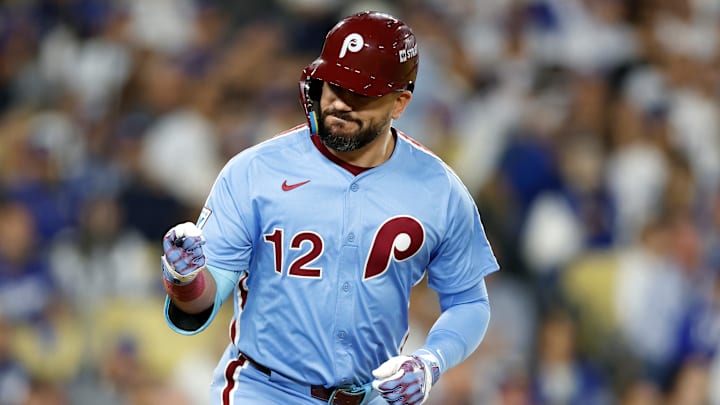
Kyle Schwarber (DH/LF, Phillies)
If Atlanta lets Marcell Ozuna walk after his down year, Schwarber is the cleanest plug-and-play DH on the board: 40-plus-homer power, postseason credibility, and a reputation as a clubhouse tone-setter. Signing him would also siphon juice from Philadelphia’s lineup while boosting Atlanta’s — a two-for-one Braves fans would savor whenever the schedule turns to NL East play.
The Phillies are widely expected to issue a qualifying offer, and they won’t roll over if a division rival gets aggressive, turning any pursuit into a two-front battle: Philly’s wallet on one side, and the draft-pick math that comes with a QO rejection on the other. For context, Schwarber just finished 2025 at .240/.365/.563 with 56 homers, 132 RBIs, and a 150 OPS+.
KYLE SCHWARBER DID IT AGAIN! pic.twitter.com/FpRDnZNERp
— Philadelphia Phillies (@Phillies) September 24, 2025
The Braves need a steady, bankable DH outcome rather than another bet on variance, and Schwarber’s year-over-year thump fits that brief. If Ozuna isn’t re-signed, Schwarber becomes the highest-leverage way to stabilize the middle of the order in 2026 — and he’d do it while weakening the club you measure yourself against every October.
Ranger Suárez (LHP, Phillies)
Rotation help is a front-burner item, and Suárez answers a few different Braves problems at once: he’s left-handed, he carries postseason nerve, and he’s built a track record of run prevention that plays in any park. The Phillies are expected to tag him with the QO, and rival-shopping a division ace-adjacent arm isn’t usually cheap — but Suárez profiles as the kind of stabilizer Atlanta lacked when injuries mounted in 2025. Even if the sticker price lands south of the very top arms, the total acquisition cost (contract plus draft capital) is what Anthopoulos will scrutinize.
The Braves know Suárez well and dropping him into a rotation that needs reliable volume shifts October matchups before a single pitch is thrown. If the front office decides the pick penalties are survivable for a multi-year rotation fix, Suárez might be the rare within-division strike that makes strategic sense.
Michael King (RHP, Padres)
Atlanta already kicked the tires on King last winter, and now he’s back on the open market after declining his mutual option with San Diego. The San Diego Padres must decide whether to float a qualifying offer, and recent reporting suggests that possibility is very real. But either way, the fit is obvious: when healthy and fully stretched out, King’s starter version (2.95 ERA in 2024) looked like a playoff rotation piece, not just a depth play.
That said, his 2025 season was beset by a pinched nerve in his throwing shoulder — he landed on the injured list in late May with right-shoulder inflammation and later was transferred to the 60-day IL as the nerve issue lingered. If the Braves are budgeting for one premium bat and one swing-and-miss starter, King’s upside still makes him a compelling hedge against the top-shelf prices for the market’s headliners.
Prior interest matters; the scouting work is already on file, and the need (post-Fried and Morton churn) hasn’t gone away. If King receives and declines a QO, the same draft-pick math applies — but the ceiling relative to contract length could look friendlier than the very top arms, making him a value-tilted way to raise the rotation’s October ceiling.
The QO for 2026 sits at $22.025 million. Players who reject it hit the market attached to draft and international penalties for the signing team — the exact penalty tier depends on the club’s revenue-sharing or CBT status, but the principle is the same: beyond AAV and years, you’re paying in picks and bonus pool. That doesn’t disqualify Atlanta from this tier; it just forces Anthopoulos to be choosy about which QO-tied star justifies the total cost.
All three names solve real Braves problems. If the Braves decide one QO-attached splash fits the 2026 window, Schwarber (if Ozuna departs) and Suárez (if the rotation is priority one) sit atop the intrigue list, with King as the high-upside pitching play. The board is set; now it’s about choosing where a draft pick is worth turning a rival’s strength into Atlanta’s edge.
 Add us as a preferred source on Google