

The Atlanta Braves made franchise history Tuesday morning by signing Chris Sale to a contract extension that makes him the highest-paid player in club history by average annual value. Sale’s $27 million extension for the 2027 season surpasses the previous franchise high of $23 million AAV set by Josh Donaldson in 2019. While committing this level of annual salary has not typically been Alex Anthopoulos’s approach, Sale represents a uniquely compelling exception to that trend.
Given the uncertainty within the rotation, the Braves had little choice but to secure Sale beyond 2026, and they did so at a figure that compares very favorably with other top-tier starters across the league. From a value standpoint, the extension is more than defensible.
However, allocating that level of salary to the 2027 payroll — and potentially 2028 as well — could influence how aggressively Atlanta approaches next offseason. The added financial commitment may limit flexibility at the top of the market. The question now becomes whether the Braves will be positioned to pursue elite free agents in 2026–27, or if Sale’s extension signals the start of a more selective, internally focused roster-building strategy.
More Sale: "We have a great manager, great front office, core group of players that are gonna be here for a while, good young talent coming up. Excited for that. I wanna be here for that. And it gets you guys off my back asking me if I’m gonna retire at the end of this year.”
— Chad Bishop (@MrChadBishop) February 24, 2026
Here are some 2026-2027 free agents the Braves could miss out on because of the Chris Sale extension
Next year’s free agent class is expected to feature a significant amount of high-end talent on the open market, particularly on the pitching side. While extending Sale solidifies the front of the rotation, it could complicate the Atlanta Braves’ spending flexibility next winter. With several premier starting pitchers projected to headline the class, Atlanta may have to weigh the benefits of pursuing another top-tier arm against the long-term financial commitments already on the books.
At the top of the market is two-time reigning AL Cy Young Award winner Tarik Skubal. Although Atlanta was unlikely to seriously pursue a contract at that level, Skubal’s deal could reset the pitching market. If he establishes a new financial benchmark, the ripple effect may drive up prices for the next tier of starters, potentially pushing them beyond the comfort zone of Alex Anthopoulos and limiting the Braves’ ability to compete for upper-tier arms.
Freddy Peralta
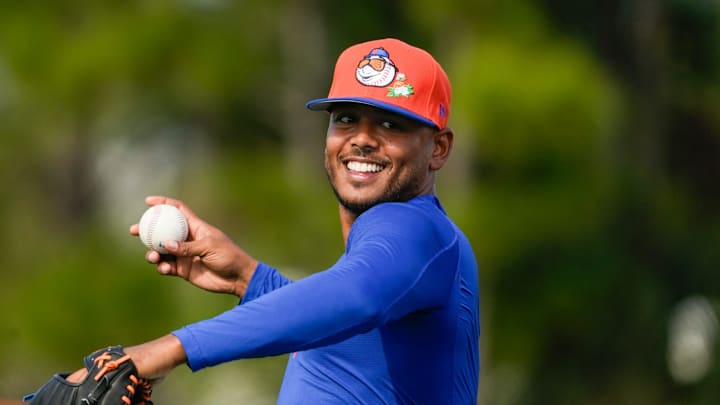
In the next tier of starting pitchers is current New York Mets right-hander Freddy Peralta. The former Brewers standout is set to pitch in Queens full-time in 2026 after the Mets dealt significant prospect capital to strengthen their rotation. What comes next remains uncertain, but another strong campaign could position Peralta to command a substantial contract next winter.
The Braves were reportedly interested in the right-hander this past offseason, and if his market remains within a manageable range, Atlanta could position itself to be competitive for his services. However, escalating prices across the pitching market may ultimately determine whether that pursuit is realistic and the money owed to Sale now could complicate that decision.
Kevin Gausman
Former Atlanta Braves right-hander Kevin Gausman has revitalized his career since departing Atlanta. Following his resurgence with the Giants, Gausman has posted a 3.34 ERA and 3.12 FIP while striking out more than 1,000 batters across the 2021–2025 seasons.
Gausman has since anchored the Toronto Blue Jays rotation for the past four years and is once again set to enter free agency, this time ahead of his age-37 campaign. If the Braves are seeking a proven veteran who fits the “capable of a postseason start” profile, Gausman would represent a compelling option given his durability and track record in high-leverage situations. The key question, however, is whether his next contract will extend into years and dollar figures that exceed Atlanta’s comfort zone especially knowing that they might exercise Sale's $30 million option.
Michael King
We conclude this brief list with a pitcher who entered the market this offseason. Michael King likely would have commanded a significantly larger contract this winter if not for a 2025 season largely lost to injury and the Qualifying Offer attached to his name.
King re-signed with the Padres on a three-year, $75 million contract, which includes player opt-outs following each season. If he can maintain his health and perform effectively in 2026, it is reasonable to expect that he may exercise his opt-out and re-enter the open market.
A pitcher of King’s caliber would appear to fit perfectly with Anthopoulos’ approach, but limited financial resources could make it challenging to outbid other organizations in need of pitching. Ultimately, the Braves were compelled to re-sign Chris Sale, given the uncertainty surrounding the top of their rotation beyond 2026. While the contract could ultimately prove to be a bargain, the financial commitment may limit the Braves’ ability to pursue other targets in next winter’s market.
 Add us as a preferred source on Google