

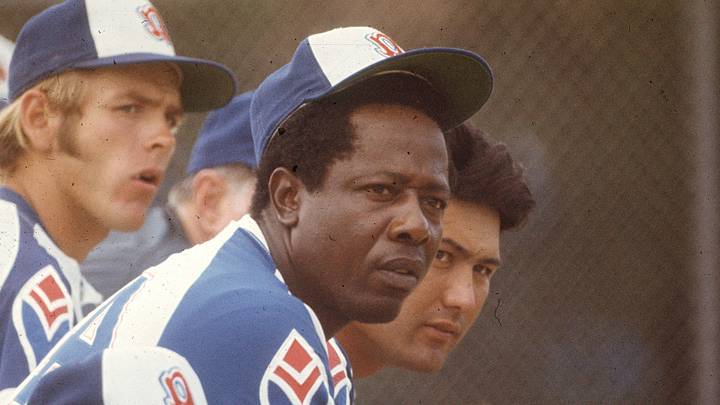
During the course of Atlanta Braves history, some of the greatest players to ever play the sport of baseball have worn their uniform. If you go ALL the way back and include very early-era players, there are over 50 players in the Hall of Fame right now who played for the franchise for some amount of time.
Now, many of those stints were short, and for every Hall of Famer, there are at least 100 guys who were pretty ordinary to downright terrible. That is just the nature of sports in general, but those who put together special seasons tend to get remembered fondly the most by fans and experts alike.
So, what are the best individual seasons in Braves franchise history? We are glad you asked.
Here are the greatest individual seasons in Braves history in the live ball era (by rWAR)
Comparing eras is already impossible when talking about the best seasons of all-time, but that is particularly true when you get into the really early years of baseball. As a result, we restricted this list to the Live-ball era. It isn’t perfect, but that way we at least know that everyone was playing close to the same game.
Also, these rankings are organized by Baseball-Reference WAR (rWAR). If you prefer Fangraphs WAR or other metrics, more power to you. Using WAR in this situation is the best and simplest way to put together rankings like these without introducing too much subjectivity to the process. If you have a favorite season that you think should rank higher, that is great! However, that will not change these rankings, nor does it mean we will cheat to let Chipper Jones appear on the list (spoilers).
25. Eddie Mathews, 1963 - 8.0 rWAR
Eddie Mathews is an unsung hero of Braves franchise history. Mathews’ 1963 was particularly noteworthy, if for no other reason than that it appears as though it was under-appreciated even back then. Despite posting an 8 WAR season, Mathews didn’t finish in MVP voting at all, nor did he even make the All-Star team. Mathews’ home run power had started to diminish by this point, as he only managed to hit 23 homers at 31 years old. However, a .399 OBP covers a lot of flaws, and he still had more walks than strikeouts.

24. Hank Aaron, 1960 - 8.0 rWAR
We start the bottom of the 25 greatest seasons in Braves history with two franchise greats. All told, this is the lowest of Hank Aaron’s seven appearances on this list, and that number would go up significantly if we extended these rankings another 5-10 spots. If anything, that says all that needs saying about Aaron. He was the model of consistent excellence, and 1960 is just one example of that excellence. This was when Aaron was at the height of his powers, and in the middle of five straight 8+ rWAR seasons. In 664 plate appearances, Aaron cracked 40 homers and drove in 126 runs.
23. Hank Aaron, 1969 - 8.0 rWAR
Told you that weren’t done seeing Aaron in these rankings, as he is showing up several more times, including his 1969 season. At this point, the Braves had made their move to Atlanta a few years prior, and Aaron’s Hall of Fame candidacy was very well established. However, despite being 35 years old at the time, Aaron hadn’t shown much sign of slowing down at all other than on the bases. His 8 rWAR campaign in 1969 came with 44 homers, 97 RBI, and almost twice as many walks as strikeouts.
22. Eddie Mathews, 1953 - 8.1 rWAR
Hey, there is Mathews again. Mathews got his start in the majors during the final year that the Braves were in Boston, and his rookie season went pretty well. However, that first year in Milwaukee was also the year that Mathews transformed into a star. During his sophomore campaign, Mathews ended up hitting a career-best 47 homers with a 1.033 OPS, which was also a career high. Mathews would help lead the Braves to a 92-62-3 record in 1953 and a second-place finish in the National League.
21. Eddie Mathews, 1959 - 8.2 rWAR
Mathews is the all-time great who gets glossed over too often in Braves history. That is largely due to Mathews lacking in particularly loud numbers and/or achievements, as well as playing most of his career with the Milwaukee Braves, where he would soon be overshadowed by Hank Aaron. However, Mathews is still a Hall of Famer who could absolutely mash, and his 1959 season was the finest example of that. Mathews led the league in homers that year with 46, and his .983 OPS was good enough to finish second in MVP voting behind Ernie Banks, who was admittedly awesome that season.
20. Andruw Jones, 2000 - 8.2 rWAR
It is actually surprising that it took this long to see Andruw Jones’ name pop up on this list given how much value he gained from his defense alone. However, it is even more surprising that this is also Jones’ only appearance in these rankings. Jones had several really, really good seasons with the Braves, but the future Hall of Famer’s best one came in 2000, when he posted a .907 OPS with 36 homers, 21 stolen bases, and still managed to find time to be the best defensive center fielder on planet Earth. This would also be the last season where steals were a bit part of Jones’ game, as he slowed down almost immediately afterwards.
19. JD Drew, 2004 - 8.3 rWAR
Who is ready for pain? The JD Drew trade is one that is mostly remembered as a disaster, as the Braves gave up eventual Cy Young contender Adam Wainwright as well as Jason Marquis and Ray King for what amounted to one season of Drew. However, what fans seem to forget is that Drew was awesome for that one season, and his 2004 campaign ended up being the best season of his 14-year career. Drew posted a .305/.436/.569 line with 31 homers and 93 RBI in his lone season in Atlanta.
18. Tommy Holmes, 1945 - 8.3 rWAR
Tommy Holmes’ playing career only ended up being 11 seasons (most with the Boston Braves), and he only played that long because he had a short stint as a player-manager. The first seven seasons of Holmes’ career were very solid, but his best season was easily 1945, and it also happens to be one of the best seasons in Braves franchise history. In addition to being a highly-regarded defensive outfielder, Holmes gave Boston a .997 OPS and career highs in homers (28) and doubles (47). Holmes fell just short of winning MVP, but he was clearly the more valuable player than eventual winner, Phil Cavarretta.

17. Ronald Acuña Jr., 2023 - 8.4 rWAR
We finally arrive at Ronald Acuña Jr.'s vaunted 40/70 season, and it was a sight to behold. Acuña Jr. closed out the first season of its kind in baseball history by winning the NL MVP award unanimously over Mookie Betts, old friend Freddie Freeman, and teammate Matt Olson. Betts made things interesting, but any season that has a guy not only hit 41 homers and stole 73 bases, but also slashed .337/.416/.596 is going to be tough to beat. Amongst those who prefer counting stats when thinking about the all-time great seasons, Acuña Jr.'s 2023 season is up there.
16. Johnny Sain, 1948 - 8.5 rWAR
Johnny Sain is not a name that immediately pops into Braves fans’ heads when talking about the franchise’s history, but maybe he should be. For the three years following his service in World War II like teammate Warren Spahn, Sain was one of the best pitchers in baseball before his career dove off a cliff following his historically good 1948 season. In 314.2 innings (no wonder his arm didn’t hold up) for the Boston Braves that season, Sain posted a 2.60 ERA and 3.53 FIP and won 24 games. Sain started 39 games (42 appearances total), and 28 of those starts ended up being complete games. Early baseball was weird.

15. Greg Maddux, 1994 - 8.5 rWAR
Oh, what might have been. Maddux was on his way to authoring one of the absolute best pitching seasons we have ever seen in 1994, and it honestly still is in a lot of ways. In addition to an insane 1.56 ERA and 2.39 FIP across 202 innings, 10 of Maddux’s 25 starts in 1994 ended up being complete games. There is just no other pitcher like Maddux in baseball history. Unfortunately, the 1994 baseball strike cut the season short in August, and we will never know just how far Maddux could have taken this historic season.
14. Tom Glavine, 1991 - 8.5 rWAR
Tom Glavine was more known for his consistent excellence than for any standout performance, as he averaged more than 4 rWAR from 1992-2005. However, Braves fans of a certain age remember the 1991 season well. Not only was that the famous “worst-to-first” season that saw Atlanta heartbreakingly lose in the World Series in seven games, but it was Glavine’s finest season by a wide margin. In winning the first of his two Cy Young Awards, Glavine put together a 2.55 ERA and 3.06 FIP across 246.2 innings while walking just 69 batters. 1991 would always be the first of five times when Glavine would lead the league in wins, as his 20 wins finished on top.
13. Hank Aaron, 1967 - 8.5 rWAR
Lets take a moment to appreciate just how consistently great Aaron was in his career. 1967 would be the second-to-last time that he would post a season of 8 WAR or higher, but he would still manage to accumulate 35.6 rWAR over the following six seasons before really slowing down in the final three years of his career. In 155 games in 1967, Aaron slashed .307/.369/.573 with 39 homers and 113 runs scored. This was also during the period when Aaron was still stealing some bases, with 17 thefts along the way.
12. Hank Aaron, 1962 - 8.6 rWAR
Oh look, another insane Hank Aaron season. Despite his status as the Home Run King for decades, Aaron never really had one season where he posted a crazy home run total. Instead, he just hit around 40 homers every season for almost 17 seasons, which is crazy to think about now. However, 1962 saw Aaron post the second-highest single-season home run mark of his career with 45 bombs. His career high came during the 1971 season, which does not appear on this list, where he hit 47 homers in 139 games.
11. Hank Aaron, 1959 - 8.7 rWAR
It is kind of funny that Aaron’s lone MVP season in 1957 wasn’t particularly close to being his best season with the Braves. In fact, looking at his 1959 campaign, you would think he would have won half a dozen of them. Sadly, he had to settle for third place behind Ernie Banks and teammate Eddie Mathews in 1959, but a 1.037 OPS and 400 total bases speak volumes about what sort of season Aaron put together. Fun fact: Aaron’s .355 batting average this season was a career-high by almost 30 points, and he also won the batting title.
10. Warren Spahn, 1953 - 8.8 rWAR
If one is going to finish up a run for the ages over nearly a decade, you could do a whole lot worse than the season Warren Spahn put up during the inaugural season of the Milwaukee Braves in 1953.
Spahn’s innings pitched numbers weren’t completely crazy at 265.2 back then, even though the idea of throwing that much these days seems objectively insane. The reason why Spahn’s 1953 makes this list is largely because it was arguably his best season when you are looking specifically at rate stats, with career bests in ERA (2.10) and hits per nine innings (7.1) to go along with pitching excellence across the board.
9. Lonnie Smith, 1989 - 8.8 rWAR
Lonnie Smith had a better career than most people think he did. Part of that was because Smith hopped around the league and ended up playing for six different teams in his 17-year career. His second-best season came in 1982 when he was with the Cardinals and finished second in the MVP voting behind Braves legend Dale Murphy. However, it was his 1989 season with the Braves that proved to be his greatest season, and one of the best seasons, period, in franchise history.
Smith never really hit for much power, so everyone was pretty surprised that he hit 21 homers that season. However, Smith was locked in in all aspects at the plate with a .315/.415/.533 slash line with 25 stolen bases as well. If you can sustain a .400+ OBP over the course of a season, good things are going to happen. If you can do so and also have a career year in every other aspect of offense, that's when the numbers can start getting pretty wild like Smith’s were.
8. Phil Niekro, 1977 - 8.9 rWAR
Niekro has “only” two seasons on this list, but he sure made them count. As is often the case with knuckleballers, Niekro’s excellence got ignored by awards voters, and he didn’t even make the All-Star team in 1977. However, that doesn’t change the fact that it was a season for the ages.
Niekro’s 4.03 ERA doesn’t seem like much at first glance, but throwing 330.1 innings across 44 appearances, including 20(!) complete games, has its advantages. Niekro also had a 3.74 FIP over the same span, so his ERA didn’t completely reflect how well he pitched. Another part of Niekro’s dominance in 1977 came from the fact that he also led the league in strikeouts with 262, which ended up being a career-high for the future Hall of Famer.
7. Rogers Hornsby, 1928 - 8.9 rWAR
Rogers Hornsby isn’t really a name that is associated with Braves lore very often. Sure, he is absolutely one of the best hitters to ever live, but Hornsby is far more well-known for his time in St. Louis. However, Hornsby was traded to the Boston Braves for the 1928 season, and he made his short stint with the Braves count with an 8.9 rWAR.
Looking at these early Live-ball era offensive seasons is funny, because it is such a far cry from what we have grown to value in modern days. However, Hornsby’s 1928 season is great by any measure in any era, as he posted a .387/.498/.632 line with 21 homers and a 202 OPS+. Unfortunately, the Braves were in a bad place financially at this point in time, and they ended up trading Hornsby to the Cubs for $200,000 and five players. Hornsby would go on to have one more really good season in 1929 with Chicago before injuries and age finally caught up with him.
6. Darrell Evans, 1973 - 9.0 rWAR
Darrell Evans is not a name that many younger Braves fans are probably familiar with. The Braves actually picked Evans in the 1968 Rule 5 Draft, which proved to be a great decision given how good (and underrated) a career Evans would go on to have. It took Evans a few seasons to really find his stride, but his 1973 season was the beginning of quite the run of being one of the more feared power hitters in baseball.
Despite an 18th-place finish in MVP voting (yes…somehow 18th), Evans’ 1973 campaign had almost everything you want from a hitter. Evans led the league in walks, connected for 41 homers and 104 RBI, and posted a very impressive .959 OPS. Evans would go on to play in parts of eight seasons in a row for Atlanta, and spent over a decade combined with the Giants and Tigers after that before returning to the Braves in 1989 and retiring.
5. Hank Aaron, 1963 - 9.1 rWAR
The second-highest of Aaron’s seven entries on this list was a fun one. Aaron was coming off his eighth-consecutive All-Star season and a sixth-place finish in MVP voting (by the way, that Aaron only won a single MVP award remains one of baseball history’s greatest injustices). It was hard to think that Aaron had much more left in the tank after such a run of dominance, but he absolutely did.
In short, Aaron was at or near the top of nearly all of the counting stat leaderboards that people care about. Aaron led the league in runs (121), homers (44), RBI (130), slugging (.586), OPS (.977), OPS+ (179), and total bases (370). It is hard to be too upset about losing MVP to Sandy Koufax’s transcendent 1963 campaign, but there is no way Aaron should have finished behind Dick Groat’s strictly worse season.
4. Warren Spahn, 1947 - 9.5 rWAR
Braves legend Warren Spahn makes the highest of his two entries on this list thanks to his stellar 1947 season. Spahn was only a couple of years removed from serving in the military during World War II as a combat engineer, where he was awarded a Purple Heart. His time in the Army did hurt Spahn’s career numbers, but he wasted little time getting going once the war ended.
Again, pitchers were handled very differently back in the old days, so a lot of Spahn’s value comes from the fact that he threw 289.2 innings. However, that does not mean that Spahn wasn’t also incredible, as he posted a 2.33 ERA and 3.40 FIP across his 40 appearances. His 1947 season began a seven-year run on the mound that few pitchers in baseball history have matched since.
3. Hank Aaron, 1961 - 9.5 rWAR
We have finally reached Aaron's highest ranked season on this list (yes, he only comes in third place here). What is there really to say about Aaron beyond the fact that he has a very strong argument for being the best player to ever live? Ignoring the obvious home run records, Aaron AVERAGED 7.7 rWAR a season from 1955-1971, which is ridiculous. Most players’ careers don’t last 17 years, but Aaron put up MVP-level production for that long plus six more lesser seasons after that.
There are so many great Aaron seasons to pick from, and there are several to choose from in these rankings, but the WAR leaderboard has his 1961 season as his greatest. Aaron hit “only” 34 homers that year, but he led the league in doubles (39) and total bases (358), while posting a .327/.381/.594 line. However, Aaron did not win MVP in 1961 despite those numbers, which is wild. In fact, Aaron only finished in eighth place, with Frank Robinson and his league-leading 1.015 OPS getting the win.
2. Greg Maddux, 1995 - 9.7 rWAR
In modern baseball history, there are few pitchers that are held in as high esteem as Greg Maddux is. You don’t win four Cy Youngs and make eight All-Star teams without some big years on the mound, and Maddux was the author of seven different seasons where he posted a rWAR of 6.5 or higher.
Maddux’s finest season (by WAR) also came during the same season where he got his only World Series ring in 1995, although he was on pace to beat that during the strike-shortened 1994 season. In short, Maddux was ridiculous with a 1.63 ERA across 209.2 innings, including 10 complete games. The voters got this one right, as Maddux won his fourth and final Cy Young this season in unanimous fashion (and rightly so).

1. Phil Niekro, 1978 - 10.0 rWAR
Most Braves fans would have expected one of Hank Aaron’s premier seasons to top these rankings, and that would have been a great guess. However, Phil Niekro has always been a unique case, not only because he was the greatest knuckleballer to ever live, but also because he pitched in an era where pitching 300+ innings a season was possible.
All of those innings really add up when you are talking about a cumulative stat like WAR, and Niekro’s 1978 campaign featured his second-most innings in a single season (334.1) across 42 starts with a 2.88 ERA and 2.76 FIP. Somehow, Niekro only finished sixth in Cy Young voting that season, as he finished behind Gaylord Perry (4.3 rWAR), Burt Hooton (5.1), Vida Blue (5.8), JR Richard (4.1), and Kent Tekulve (3.4). It was a different time, but Niekro’s all-time great season still lives on in Braves lore despite the lack of a trophy at the end of it.
 Add us as a preferred source on Google