


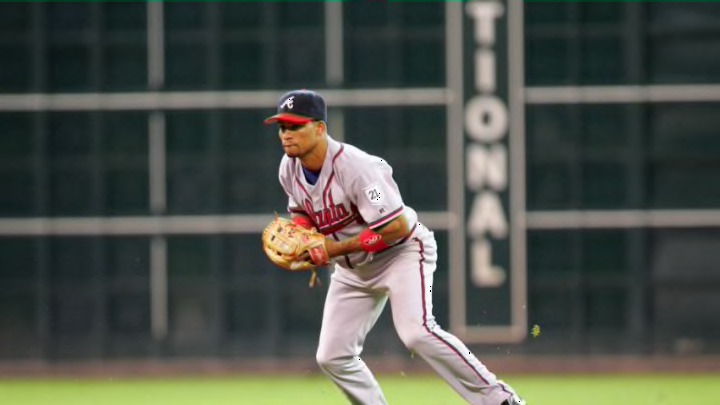

Number two – Rabbit the first
Current Atlanta Braves’ second baseman Ozzie Albies and Rabbit Maranville have a lot in common. Both stood 5-8 inches tall, both started as undersized shortstops, and on the basepaths, both use speed, though Maranville did it more often, stealing 71 bases in his first three seasons. More importantly, both sparked their team to postseason play.
The Boston Braves acquired Rabbit in exchange for Brad Hogg and $1,000. Maranville. Later in his career, Braves manager George Stalling would rave about Rabbit’s play.
"Maranville is the greatest player to enter baseball since Ty Cobb arrived. I’ve seen ’em all since 1891 in every league around the south, north, east, and west. He came into the league under a handicap–his build. He was too small to be a big leaguer in the opinion of critics. I told him he was just what I wanted: a small fellow for short. All he had to do was to run to his left or right, or come in, and size never handicapped speed in going after the ball."
Stallings’ memory did a small rewrite, at least according to the Maranville on page 15 of his book Run Rabbit Run.
As Rabbit tells it, a teammate told him after their afternoon workout in the spring of 2013, that Stalling’s nephew Art Bues would get the starting shortstop job.
"(Maranville) said, ‘If I couldn’t play ball better than that guy I’d quit.’"
It’s likely his teammate had set Rabbit up because Stalling was walking behind them and overheard his comment. That night he told Rabbit he’d have to shape up or get traded. In the end, Bues suffered an injury, Maranville got the job and kept it for the next eight years
He finished third in the 1913 NL MVP race and second to his double-play partner Johnny Evers in 1914. I wrote extensively about Maranville’s play during the 1914 Miracle Braves worst to first run last year.
"During the 1914 season, he led NL shortstops in games (156), Innings (1397, chances (1046), notched over 100 more put-outs than any other SS and made only 62 errors. . . .Mike Lynch called Maranville’s defense “otherworldly.” Today that’s 6.29 fielding runs a game (RF/G) and 4.2 dWAR"
Not known for his bat, Maranville put together a monster World Series, hitting .308/.400/.308/.708, stealing two bases and driving three runs.
Over his initial eight-year stretch with the Braves (1913-1920), Maranville batted .252/.311/.340/.651, with a 91 OPS+. He totaled 998 hits, 316 walks, laid down 126 sac-bunts, and stole 156 bases.
The Braves traded Maranville to the Pirates for Billy Southworth in 1921, and he bounced around the League, until returning to the Braves in1929, after earning a comeback year tenth place finish in MVP; that renaissance continued with the Braves.
Now 37 years old, Maranville batted .284/.344/.366/.710, posted 2.5 rWAR, 2.1 dWAR, and finished #15 in the NL MVP race. He also finished #10 in 1931, #17 in 1932, and #12 in 1933.
A severe ankle injury in a spring training game cost Maranville the 1934 season. Though he tried to play the following season, his career effectively ended with the 1933 season.
Altogether, Maranville spent parts of 15 seasons with the Braves, appeared in 1795 games, stole 194 bases, and batted .252/.313/.329/.642.
In 1954, two weeks after his death, The BBWAA elected Rabbit Maranville to the Hall of Fame, with 209 of 252 members voting.