


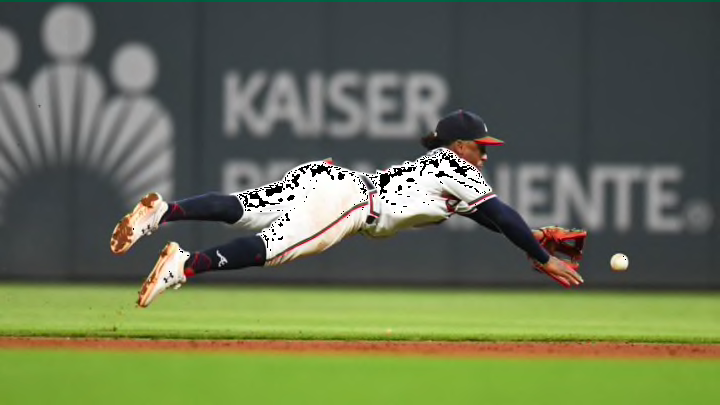

Depending on whose metric you prefer, the Atlanta Braves were either very good, mediocre, or poor in 2019. Most agree they know good defense when they see it, but nailing it down to a number isn’t that easy.
Atlanta Braves GM Alex Anthopoulos emphasizes good defense, but how do we know what that means. Typically, today’s game relies on metrics, but unlike batting and pitching, placing a number on defense is hard – make that extremely difficult and complex.
It’s also impossible to compare infield and outfield defense – catching is a universe of its own – and it’s hard to argue player X over player Y, particularly across different eras. If a brief background in defensive metrics bores you, feel free to skip to the next slide.
In the beginning, there was a simple concept: a player who should make a play any average player should make but doesn’t, made a mistake or an error. The error begat fielding percentage as a way of figuring out who made fewer mistakes over a season or a career. In other words, who played that position best in terms of defense.
As the game changed and players began to move around the diamond, errors lost some of their hutzpah. Along the way, the idea that a player who doesn’t get a glove on a ball, even if he’s standing next to it, doesn’t deserve an error took hold.
Players knew good statistics meant better pay as far back as 1917 when William F Kirk penned Chances. It’s a long ode that starts like this.
"When the fielder loves his record More than victory for his team Doubtful chances miss his glances For his caution is extreme. Going after every grounder Means a slip-up here and there, And in terror of an error He will choose the chances fair. . ."
When fans started seeing games live on TV, they found out what reporters knew all along; home town scorekeepers often assign an error when it favored the home team. Suddenly errors weren’t as convincing as many fans believed. People who loved the game and were handy with math looked for something to replace the error, which they considered a flawed way to measure quality.
John Dewan, who worked with Bill James Project Scoresheet, founded STATS in 1987, and eventually, Baseball Info Solutions in 2003 (now Sports Info Solutions), and developed Zone Ratings. According to Sean Smith, writing for The Hardball Times, zone ratings first popped up around 1987.
In 2006, Dewan’s Sports Info Solutions published the first issue of the Fielding Bible. ,
"“. . . the first and most complete review of defensive metrics. . .”"
The plus/minus system called defensive runs saved (DRS) made its debut in that first Fielding Bible. Today’s The Fielding Bible website uses 4,223 words on its FAQ page, to provide a simplified explanation of DRS.