



While some players and teams weren’t so lucky, the pile of Braves’ arbitration-eligible players were all signed up to new contracts for 2019.
The system for determining contract sizes for MLB players with 1-3 years of experience is pretty cold and straightforward … almost clinical. Subject to the mandated league minimum salary ($555,000 this season), the Atlanta Braves and their 29 other rivals are permitted to set those salaries to whatever number they see fit to assign.
Players with 4-6 years of experience (I’m going to intentionally skip the exception clauses today) get to argue the point, and this happens in 2 phases: actual negotiation and then via a ‘trial’ in front of an arbiter if no agreement is reached.
It’s a nutty system, for teams spend 51 weeks of the year in which they talk about how great their players are and how each one is a solid contributor to the overall success of the club… yada, yada…
But if you get to arbitration, the team basically is obligated to argue how much a player of theirs is flawed and not living up to the standards that would merit the salary they are asking for.
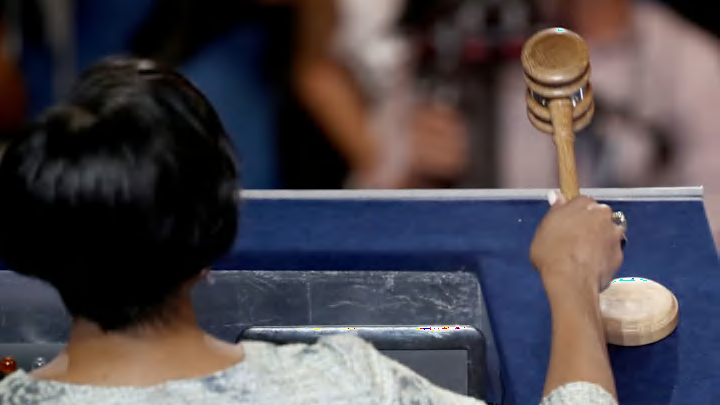
It’s not like the arbitrator can choose a number, either. When all parties enter the conference room in which the hearing is held, there will be 1 winner and 1 loser… the team will have a number to defend; the player and his agent will have a number to defend.
The arbitrator has to decide who is most correct in the arguments presented and declare the victor. It is therefore an adversarial encounter. The victor’s price becomes the contract price.
End. Over. Done.
A Change is Needed
This system – which isn’t entirely friendly in the best of circumstances – might need an overhaul, too, given the new manner in which teams are now valuing players (particularly older players).
A player’s peak performance years are typically in the range of their age 26-31 seasons… at least in this post-steroidal era. During that era, we all got used to seeing many players continue to excel at the sport well into their mid- and even late-thirties… and they were paid accordingly.
But now the dropoff is noticeable, and with many players barely out of the arbitration system by ages 26-31, the money isn’t being passed out at the rate once seen.
"The average major league salary dropped this year for the first time since 2004 and for only the fourth time since record-keeping started 50 years ago, according to the players’ association. The union said Friday its final average was $4,095,686, down $1,436 from $4,097,122 last year."
There are some reasons for this particular drop, but it’s still a rare thing… and one that feels like a trend is in progress; a trend that will anger the union.
Change is difficult
The current MLB Collective Bargaining Agreement – the document that sets all of these rules – is up for renegotiation after the 2021 season. This topic plus free agency issues are likely to shut down the sport for a while by then.
The ownership of MLB teams have to like things as they are; the players’ association already did a poor job of negotiation in 2016 and will want sweeping changes… and they don’t have a lot to give up in return.
That’s a lead-in for a discussion that will be had in earnest in another 24-36 months from now, but you can expect it to hit the fan then… probably right after the Braves win the World Series of ’21.