



The Atlanta Braves added another reliever yesterday and are still working to reinforce the bullpen and rotation before the nonwaiver trade deadline Tuesday.
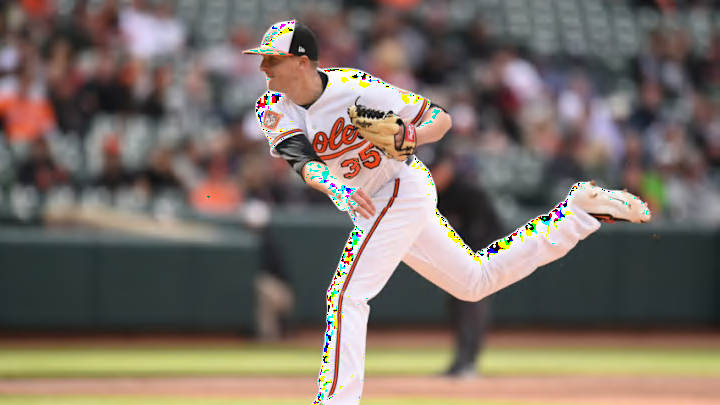
Immediately after yesterday’s victory over the Dodgers, the Atlanta Braves announced the acquisition of Brad Brach from the Orioles. The Braves once again used international bonus pool money instead of players or prospects to acquire Brach.
Alan gave you a quick rundown on the big right-hander yesterday, but many haven’t seen him pitch and don’t know what to expect. I’ll clear that up today,
A lot of buzz started around game time on Sunday because the Braves scratched Kolby Allard from his start with Gwinnett and inserted Luiz Gohara. Speculation originally centered around a deal for Texas closer Keone Kela and in some tweets Jake Diekman. Those rumors proved inaccurate, at least as they were structured then.
When the news about Brach broke some may have thought he and Kela were set to do the same job. That’s incorrect. While Brach closed for the Orioles last season and added eleven more saves this year, he’s best used in middle relief and worked multiple innings for Baltimore before jumping in when Zack Britton ruptured his Achilles Tendon last year.
The arsenal
According to Texas Leaguers, Brach uses four pitches but relies heavily on his four-seam and split-finger fastballs, mixing in an occasional slider, two-seam fastball, and change.
Both his four-seam and two-seam fastball sit between 92 and 94 while the splitter checks in at 87 as does his change. The four-seamer gets a slightly below league average whiff rate while the splitter is a clear swing and miss monster… when he doesn’t leave it up in the zone.
His change and two-seam fastball are used so infrequently one wonders why he bothers. They aren’t particularly effective pitches and relievers can get by with a good split and fastball while mixing in the occasional slider.
What to expect
Brach’s been less than stellar this season. He never reached strikeout machine status but averages about one an inning. His problem – stop me if you’ve heard this before – is always related to walks.
Throughout his career, he hovered between 3.5 and 4.3 per nine and in 2016 managed to get that down to a solid 2.85. That was a one-year respite, however as 2017 saw it slip back to its usual mid-three range. This year it’s an angst-making 4.38/9.
Atlanta Braves GM Alex Anthopoulos suggested to MLB.com’s Do-Hyoung Park, that his peripherals point to pitching in bad luck.
"“We needed to add some bullpen [help]. . . .he’s not having the year he has had . . .there is some upside there . . . If you look at batting average on balls in play [BAbip], things like that are a little high."
A little high seems a bit of an understatement.
Opposing AL batters posted a .303/.375/.455/.830 line when facing Brach supported by a .374 BAbip.
This year lefties hit Brach at a .338/.411/.452/.862 clip while right-handed hitters managed only .272/8.337/.457/.794 line. He was better in high leverage situations and mostly kept the ball in the park, no mean feat at Camden Yard.
Most of us understand that a hitter may fall into a stretch where everything he hits finds a hole and his average skyrockets. On the other hand, it appears hard for a pitcher to hit that kind of bad luck streak.