


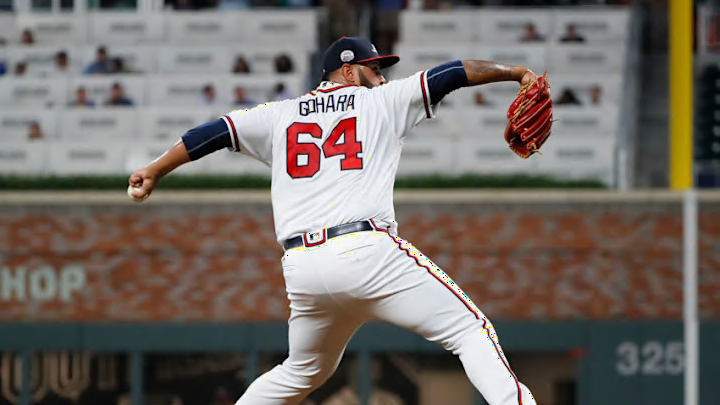

Alan wrote a few days ago about the positive fan reaction to the Braves Brazilian phenom Luiz Gohara. That discussion led to a discussion on which metric to believe which in turn requires explaining the metrics.
Alan used a fan tweet to point out it’s easy to grab a stat and use it to make a point regardless of sample size or – heaven help us – logic. The tweet in question used FIP to imply that Atlanta Braves’ young phenom, Luiz Gohara’s 2.90 FIP put him right along side Max Scherzer’s 2.94.
A 140 characters (or heaven help us 280) aren’t enough to say something like that and add context. explaining that takes time Twitter doesn’t offer. in the hope of filling that void, I offer a primer and a comparison of three metrics for your edification and discussion.
Before I start let me clarify that I’m not here to start an argument about the value of one particular metric over another. As long as we understand the intent and limitations of a metric, most of today’s advanced metrics are of value as part of an answer. If I leave your favorite out I apologize, these are the ones I see bandied about the most.
FIP
Definitions are a good starting point and for FIP I turned to Fangraphs (Some things are free on FG while subscription gets you more information.)
"Fielding Independent Pitching (FIP) measures what a player’s ERA would look like over a given period of time if the pitcher were to have experienced league average results on balls in play and league average timing . . . (it) strips out the role of defense, luck, and sequencing, making it a more stable indicator of how a pitcher actually performed . . ."
Fangraphs admits that ‘certain pitchers’ consistently out perform FIP. In other words FIP doesn’t work well for the very best pitchers. They offset that by saying it’s okay because it works for most of them.
FIP considers only home runs, walks and strike outs relative to innings pitched. Alan posted the formula but I’ll throw it in here in case you forgot.
"FIP = ((13*HR)+(3*(BB+HBP))-(2*K))/IP + constant"
The constant simply makes FIP look like ERA so it’s easier for the public to recognize and compare. All of the common pitching statistics use old-fashioned ERA as a baseline format.
Looking at the formula you can see that a great FIP results if a pitcher has a high K/BB ratio and keeps the ball in the ballpark.
In 1996 for example Greg Maddux threw 245 innings, struck out 172, walked 28 and gave up 11 home runs. His ERA and FIP were, for all practical purposes, the same -2.72 and 2.73 respectively. That makes FIP look really accurate. However that’s not always the case.
In 1998 Greg Maddux threw 251 innings, struck out 204, walked 45 and gave up 13 home runs. His ERA that season was dropped to 2.22 but FIP said it was actually 2.81. Maddux didn’t get worse, he just had a few too many walks and home runs and FIP penalized him for it.
A reminder that FIP is reflective, not predictive. It tells you what it thinks should have happened all things being average behind the pitcher, not what is likely to happen in the future. For that they have xFIP and cFIP but that’s another post entirely.
When discussing how to use FIP, Fangraphs says, “. . using FIP requires a bit of caution and it is best to think of it as a starting place for the analysis of pitcher performance. . “
If FIP is the starting point, where else do we look; I offer a couple of options.