


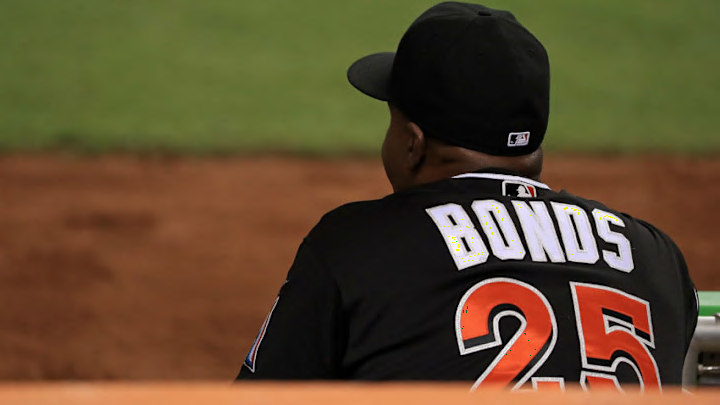
I thought perhaps society had figured this all out. That steroid use in sports is bad and ought not be tolerated. Seems that some are now campaigning to change that.
Before I get into this rant, two things must be mentioned. First, that while there is obviously a connection, the legacy of Hank Aaron has nothing to do with anything I’m going to say here. Second is the irony that Barry Bonds was oh-so-close to having been a member of the Atlanta Braves, and that fact gives me cold chills.
Few things get me really riled up in anger about sports, though when such things happen it is almost always about some sort of injustice having been perpetrated against an individual, a team, a sport, or the fans.
Such injustices can be manifested in several ways, but when boiled down, the root causes are usually bad judgment (think umpires) or cheating… and especially the cheating.
That’s why I was non-plussed last year when Roger Clemens and Barry Bonds started making serious inroads in the Hall of Fame vote totals.
- 2015: Clemens 37.5%, Bonds 36.8%
- 2016: Clemens 45.2%, Bonds 44.3%
- 2017: Clemens 54.1%, Bonds 53.8%
There are some possible reasons for this, chiefly changes in the voting membership of the Baseball Writers that are charged with the responsibility of this task. But seeing players like Fred McGriff mired in the 20-22% range or Alan Trammell failing in his final ballot (2016) just continues to eat at me.
So yesterday we noted the passing of the 10 year anniversary in which Bonds hit home run #756. The only comfort to that was that he hit it against the Nationals. But at the same time, having the Nats come back and beat the Giants on ‘Barry’s Big Day’ was also satisfying.
But this story really has stuck in my craw:
You don’t have to like Barry Bonds to embrace the magnificence of his career home run record (by @Jay_Jaffe). https://t.co/AyHy2bHN5k
— SI MLB (@si_mlb) August 7, 2017
Full disclosure: Sports Illustrated and Time, Inc. are the parent companies of FanSided, which therefore also own TomahawkTake.com. I am a contractor, not an employee, for FanSided.
In this story, Jay Jaffe tries to paint a picture that there is a moral equivalence between things that Bonds did (or is alleged to have done) for performance enhancement and things done by others – implicating Babe Ruth, Gaylord Perry, Don Sutton, Whitey Ford, Ty Cobb, Willy Mays, Mickey Mantle, and many others including – yes – Hank Aaron.
That’s not really the point here. Yes – amphetamines were used widely “to fight fatigue and gain physical and mental edges” as Jaffe himself put it. But that’s a lot closer to downing an espresso or a 5 Hour Energy drink than the engineered steroids available in the past couple of decades.
There’s quite a difference between being awake and artificially building muscle mass.
My own reaction to the tweet above was fairly succinct:
No. If anything, the passage of time and societal/sporting reactions to cheating in sports since then make him more of a pariah to baseball.
— AlanCarpenter⚾ (@carpengui) August 7, 2017
The point here? It’s about cheating. It’s about trying to win via something you did in the training room or in a dark hotel room and not by the sweat of your own brow.
Baseball has gone out of its way to try and rid the sport of such practices. How successfully? That’s still hard to quantify, but most violations seem to be discovered in the minor leagues today… so that’s encouraging. Having stiff penalties continues to show just how much the sport does not want to see a repeat of the past.
This Hindsight IS 20/20
But here’s the question for Jaffe: why did baseball do these things? Was it because of Aaron, Mantle, Mays, and those you rattled off as a means to belittle their accomplishments?
No – the steroid problem finally was taken seriously because fans were upset that the drugs were fundamentally changing the game… and that was exemplified in two people – the poster children of the steroid era: Barry Bonds and Roger Clemens.
Ten years of time passage should not make us forget crimes and suddenly begin to celebrate the person behind them.
Time can rehabilitate mistakes (like Steve Bartman), sure. But in this specific case, we’re talking about a momentary lapse based on a natural reaction – ‘gee, there’s a foul ball coming toward me… can I catch it?’
Barry Bonds built a career off of bad behavior. From cheating the system, the sport, and the fans. That’s not a momentary lapse. That’s a calculated judgment that he wanted to make himself better than anyone else in the game, and he didn’t care how that was accomplished.
I don’t care who you are in making such mockery of sporting competition: Lance Armstrong, the entire Russian Olympic team, Jose Canseco, Ben Johnson… if you’re artificially gaining an advantage, then you’re cheating yourself, the sport, and the fans. You might gain that momentary pedestal, but you’ll be marked for life.
Hopefully the rest of baseball’s writers will continue to see it that way and keep Clemens and Bonds out of the Hall of Fame, for to reward bad behavior is to effectively absolve said behavior all together.
Look, if you want to go after the icons of baseball’s past, then fine. But Jaffe should recognize that the same broad brush doesn’t nearly cover everyone in the same stroke. Bonds went way over the top and after all the celebrations and home run record chases (Sosa, McGwire, etc.)… that truly scared people.
And the sport reacted properly.
Lessons Not Learned
More from Tomahawk Take
- Braves News: Atlanta makes a pair of trades, prospect debuts, more
- Atlanta Braves History: How the Red Stockings became the Braves
- Braves News: Atlanta Braves acquire Eli White from the Texas Rangers
- Atlanta Braves Swing Trade with the New York Yankees for Lucas Luetge
- Atlanta Braves 2012 Top Prospects Review: Zeke Spruill
On Monday, Bonds spoke to the media – which itself was something of a surprise since he tended to ignore them during his playing days.
He wished that he’d have been able to play one more year and had a chance for 800 homers. But instead it ‘stung’ because he was told that he was done and that was that.
No team offered him a contract and he was effectively forced into retirement.
Gee, Barry, why would that have been the case? Mirror much?
So even now, after 10 years of reflection (mirror pun intended), Barry Bonds still doesn’t get it.
Jay Jaffe doesn’t either.