



Seattle is Latest Club to Start Down to Road to Improving Contact
We heard a lot of this last year as Kevin Seitzer moved into the role of hitting coach for the Atlanta Braves: make contact, control the bat, use the entire field, battle the pitcher through all counts.
As fans, we embraced this new approach. In the six seasons starting in 2010, Braves’ hitters (and fans) endured seasons in which the teams had the 11th, 13th, and 42nd most offensive strikeouts in the entire league… that’s over 180 ‘team seasons’ in the 2010-2015 period.
But those were the 2012-2014 years. And then the idea that “strikeouts are okay if the power is there” became passé. The Braves responded with the 2nd lowest K-total of all teams in the league in 2015.
On that same chart of team strikeouts from 2010-2015, one team is the model for contact hitting: over those six seasons from 2010-2015, they have finished with the lowest number of strikeouts every year save one… and that year they were 3rd. It’s the Seitzer-inspired Kansas City Royals.
How good have the Royals been in avoiding the K? Well, ignoring the influence of the DH, let’s look at 2015’s numbers. In 2015, Royals’ hitters struck out just 973 times. The Braves…with the second fewest K’s… had 1107 strikeouts. Almost 14% higher.
Well, now the Seitzer philosophy is getting noticed… especially as the Royals have a World Series championship after 2 straight appearances.
Climate Change Blowing in from the Pacific Northwest
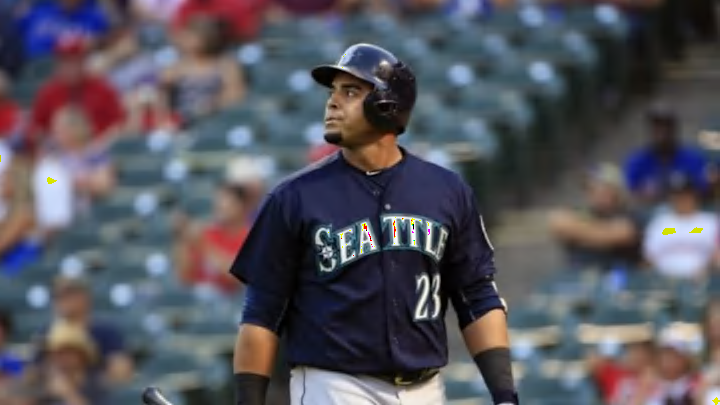
The Mariners’ new Front Office brass (Jerry Dipoto, et al) is frustrated with their team. They know they have good hitters… but many were striking out too much to be effective.
In 2015, the Astros had the worst K record in the league, but Seattle was second…with the 17th worst seasonal performance among all teams over that 2010-2015 period. It worked… kinda… for the Astros this year. It failed miserably for Seattle.
Tom Verducci of Sports Illustrated noted that Seattle held a “Hitting Summit” in January with the goal of … well, frankly, it was an attempt to channel Kevin Seitzer. He summarized the themes as follows:
"The overriding, self-styled theme of the summit was “Control the Zone.” The Mariners’ instructors talked about concepts such as “getting into good counts,” “being selective but aggressive” and “being in a good position to hit” with “separation on the back side.” But the syllabus also included the key acknowledgement that modern baseball has changed so much that hitters have to learn how to make contact with two strikes. The two-strike approach, which disappeared for a generation, is not just back, but is also once again a fundamental part of winning baseball."
Any of that sound familiar? Any of that not sound like a reasonable, fundamental approach to hitting?
So why the big change in Seattle? Because this was a team that had the 5th most homers in 2015, yet scored the 3rd fewest number of American League runs. Even the inept Red Sox had the 4th most. The World Champion Royals? 6th most in the league…despite the second-fewest AL home runs.

Verducci includes even more damning evidence against the strikeout: since 2002, there have been 14 World Series winners. Eight of those teams ranked in the top five in their league for toughest to K… and that’s been true for six of the last seven years as strikeouts have ballooned league-wide.
Meanwhile, Seattle as a whole hasn’t been a big run-scoring club since 2001… out of the Top 5 in their league every year since then.
Verducci goes into some details about the reasons for this. The Mariners were terrible last year in situational hitting – especially with runners on base (.248) and against relievers. Hitters were almost refusing to walk and instead trying to hit the ball out of the park.
Similarly, the 2014 Braves were 24th in baseball, 11th in the league in hitting (.247) with men on base. In 2015, there was some improvement to .256… even without many “hitters” in the lineup.
Braves are Already on this Bandwagon
More from Tomahawk Take
- Braves News: Braves re-sign Stephens, Will Atlanta extend Max Fried?, more
- Notable Atlanta Braves Reunions Since 2003: Pitcher Edition
- Braves News: Braves re-sign Jackson Stephens
- Braves News: Braves prospect rankings, Correa deal with Mets at risk, more
- Why the Atlanta Braves won’t extend Max Fried
There shouldn’t be any doubt as to why Fredi Gonzalez was so frustrated at his bullpen pitchers in 2015: they were giving up way too many walks in a era in which hitters don’t really want them. Check the graphic above: walks are down close to 25% since 2000 while strikeouts are up by a like amount. As the Royals have shown: if you at least put the ball in play, good things can happen.
Sure: sometimes a double-play will be the result. But the number of these in the past 16 seasons has been relatively flat: varying from 3500 to 4000 across all of baseball. That’s not nearly close to the 37,446 strikeouts recorded in 2015 (beating the 2014 record by six).
Seattle has dumped a lot of strikeouts from their 2015 roster, so they will be better in that department in 2016. Likewise, the Braves had also dispensed with a great deal of their high-K hitters before 2015 began and opted to go 180° from the hitter philosophies that have dominated baseball in recent years. To a great extent, Atlanta should be seen as an “early adopter” (behind Kansas City), though having a consistent roster to learn these tools would help, of course.
That will come in due course.
So the trends are in progress… one team at a time. It’s a trend that Atlanta is ahead of this curve by a bit, and hopefully this contact game is a philosophy that the next-arrival prospects can embrace and thrive with under Seitzer’s leadership.
Next: A Look At Pitching Prospect Thurman
Meanwhile, the Cubs and Astros will continue to espouse the K-way for at least another season.
We’ll see how that works out.