

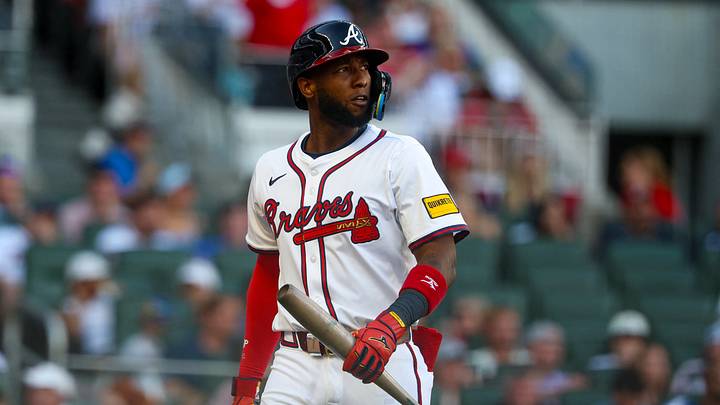
What is the worst contract in Atlanta Braves history? This is a subject where it pains you to think of potential answers, but the Braves do have a myriad of options. From long-term disaster to short-term whiffs, the Braves have missed on some notable contracts.
In an age where long-term deals are en vogue, it's easy for a team to look silly on a contract if a player begins to decline before they expected them to. However, as you will learn, short-term deals aren't free from scrutiny either.
Baseball is a sport where contracts that were once thought to be a bargain can quickly plummet if a player hits a premature decline or starts battling injuries. The Braves have plenty of examples of this throughout their history. But which contract is the worst in the history of the franchise? Some might really surprise you, while others probably still frustrate you today.
Ranking the 20 worst contracts in Atlanta Braves history
20. Austin Riley - 10 years, $212 million
At this point, what hasn't been said about Austin Riley's massive contract? The 10-year, $212 million deal remains the largest handed out in franchise history, and the early returns were more than fine. Riley was in the middle of three straight 6-bWAR-or-higher seasons, combined with top-seven NL MVP finishes, when he signed this contract.
Fast forward to 2026, and Riley has been one of the most disappointing players in baseball. Riley recently set a franchise record in strikeouts, becoming the first Braves hitter to reach 200 Ks in a season, and his 81 wRC+ is a single-season career low. Alarm bells are ringing, as Riley still has six guaranteed years left on this deal, meaning this one could rise up the list quickly before it's all said and done.
19. Dallas Keuchel - one year, $13 million
It's funny how one decision can impact the perception around a move. Dallas Keuchel was a former AL Cy Young winner brought into Atlanta in the middle of the 2019 season. The crafty lefty enjoyed a solid season with the Braves, provided a boost to the rotation, and helped Atlanta win the NL East. On the surface, a 3.75 ERA, 4.72 FIP, and 2.3 bWAR in just over 112 innings seems worthwhile for the investment Alex Anthopoulos made.
What steered this move in the wrong direction was how Keuchel was handled in the postseason. Many Braves fans have tried to forget the awful 2019 NLDS against the Cardinals, but it was the inexplicable decision to pitch Keuchel in Games 1 and 4 of that series that haunts Braves fans. This hurts even more because the decision also pushed rookie phenom Michael Soroka to start Game 3, thus eliminating him from starting twice in the series.
18. Andy Messersmith - three years, $1 million
A groundbreaking contract seems out of place on this list. The Braves signed Andy Messersmith to a three-year, $1 million deal in April 1976. Messersmith's contract was the first contract of baseball's free agency era and truly paved the way for players to obtain such a thing as free agency status.
So, how is something so historic on a worst contracts in team history list? Easy answer: the Braves didn't get the production they paid for. Messersmith put together back-to-back top-five NL Cy Young finishes with the Dodgers in 1974 and 1975. He came to Atlanta with high expectations, but he did not quite deliver. Messersmith's 1976 season was strong, but his performance fell off hard in 1977, so much so that the Braves sold his contract to the Yankees ahead of the 1978 season.
17. Spencer Strider - six years, $75 million
A contract signed at the end of Spencer Strider's magical 2022 rookie campaign, this deal got off to a blistering hot start. Strider backed up Alex Anthopoulos' decision to pay him with a 2023 season for the ages. Strider set the single-season franchise record for strikeouts (281) and led the National League in strikeouts, wins, FIP, and K/9 en route to his fourth-place finish in NL Cy Young voting.
Unfortunately, the highs of 2023 have yet to be matched. Strider has battled injuries since the historic 2023 season, and even when he's been on the mound, he has not looked like his past dominant self. After his internal brace surgery in 2024, Strider returned the following season without his signature velocity, and the mediocre results followed. This season, there was hope for a bounce back from Strider, but instead, the season turned into more injuries and worry surrounding the remaining years left on his deal.
16. Ha-Seong Kim - one year, $20 million
There is an expression that there is no such thing as a bad one-year deal in sports. Ha-Seong Kim has really put that theory to the test in 2026. The Braves have long had a shortstop problem since Dansby Swanson walked out the door in 2023, and Kim was presumed to be their 2026 solution. Sadly, things got off to an impossibly bad start for Kim.
Before the season even began, Kim slipped on some ice, which then required surgery to repair a torn tendon in his right middle finger. HSK made his season debut in May but quickly strung together some very poor at-bats. Within a month, Kim was one of the worst starters in baseball and was sent back to Gwinnett for a rehab/mental reset. Upon his recall, Kim has had some nice moments, but the season numbers are still quite bad. His .118/.211/.142 slash line, 4 wRC+, and -1.3 fWAR make him one of the worst players in baseball for the 2026 season.
15. Claudell Washington - five years, $3.5 million
Ted Turner was not afraid to swing big for his Braves, and that is exactly what he did when he signed Claudell Washington. Unfortunately, it was not the swing Braves fans wanted Turner to take at the time. In an era known as the free-agent re-entry draft, those around the team hoped Turner would splurge on outfielder Dave Winfield as the big offseason signing.
Turner instead shocked everyone by handing out a massive contract to Washington. The move was so unexpected that many owners across baseball questioned Turner's sanity. Despite that, Washington would go on to produce at around the same clip he had previously. In his five-plus seasons in Atlanta, Claudell slashed .278/.339/.435 and produced 4.7 bWAR. Unfortunately, it was more about the signings Turner missed as the '80s Braves continued to disappoint that makes this deal so memorable.
14. Sean Murphy - six years, $73 million
The Braves had already pulled off one successful trade + extension with the Oakland A's in the Anthopoulos era before double-dipping with the Sean Murphy trade. Atlanta quickly showcased their faith in Murphy by buying out his remaining two seasons of team control in favor of a deal that would keep him in Atlanta through 2028.
Sort of a theme with these Anthopoulos extensions, Murphy got off to a great start after he inked this deal. Murphy's 2023 season was his second consecutive 5-fWAR season, and things seemed to be heading toward a great path. Sadly, injuries began to snowball in 2024, limiting Murphy to 72 games. The seasons that have followed have been more of the same for Murphy, failing to eclipse 95 games played or the Mendoza line from 2024-2026.
13. Bob Wickman - one year, $6.5 million
An original trade acquisition from Cleveland, Bob Wickman stepped into the closer role for Atlanta in 2006 and flourished. Wickman was so good that the Braves extended him in September, with plans for him to pitch in the ninth inning once again the following season.
Regrettably, Wickman fell apart in 2007, and he reportedly became a clubhouse issue as well. After blowing his sixth save in 26 chances against the Reds thanks to an Adam Dunn walk-off homer, Wickman was designated for assignment by Atlanta. Eventually, reports came out that the relationship with Wickman was damaged, as complaints from Wickman about having to pitch in non-save situations ruffled some feathers in the Atlanta clubhouse.
12. Nick Esasky - three years, $5.7 million
Nick Esasky lands on this list as an example of one of Atlanta's biggest what-if signings. Esasky signed with Atlanta after a career year with Boston in 1989. The then 30-year-old was expected to anchor Atlanta's lineup for years to come.
Tragically, Esasky played in just nine games with the Braves, as the early stages of his vertigo diagnosis began to appear. Esasky went through numerous avenues in an attempt to cure his vertigo, but sadly never got the chance to take the field again.
11. Chris Johnson - three years, $23 million
The Braves had to find an answer at third base for the first time in a long time before the 2013 season. In a post-Chipper Jones world, Atlanta landed on a Chris Johnson + Juan Francisco platoon. The planned platoon did not last long, as Johnson took firm control of the job thanks to a career year.
After Johnson nearly won the NL batting title in 2013, GM Frank Wren was quick to reward him with a multi-year contract. Naturally, that BABIP-fueled 2013 season never had a shot of continuing, as Johnson regressed hard in 2014. After a -0.5 bWAR season, Atlanta stuck with Johnson for a couple of months in 2015 before ultimately trading him to Cleveland in a swap of bad contracts.
10. Len Barker - five years, $ 4.8 million
In the middle of a pennant chase, Ted Turner decided to take a swing and acquire some pitching as the Braves looked to repeat as NL West champs. To hold off the Dodgers, Turner felt RHP Len Barker was the man who could push them to the finish line. The Barker trade was accompanied by a brand-new five-year deal, the latest unnecessary risk by Turner.
This trade eventually drew headlines, thanks to Turner prematurely announcing Brett Butler as the "player to be named later" in the deal. Regardless, Barker could not stop the Braves from falling behind the Dodgers, as Atlanta missed the postseason in 1983. Barker pitched just 233 innings for Atlanta before a miserable 1985 season ended his tenure with the Braves.
9. Dan Uggla - five years, $62 million
After he had established himself as a prolific slugger with the Marlins, an intradivisional trade brought Dan Uggla to Atlanta. However, Braves fans were immediately frustrated with Uggla because the strikeouts piled up, and the defense was hard to watch at times. A 3.2 bWAR and .391 slugging percentage over four seasons isn't exactly what Atlanta thought they were getting when they traded for Uggla.
Uggla did have an infamous 33-game hitting streak that salvaged his debut season in Atlanta, but he slugged under .400 in each of the following seasons. With Uggla's signature trait declining, the Braves cut bait completely with more than a year left on Uggla's contract.
8. Mike Hampton - six years, $48.5 million
This one is a little tricky because the Braves never signed Mike Hampton in free agency. After a World Series run with the Mets in 2000, Hampton cashed in with the largest pitcher contract in MLB history with the Rockies. The eight-year, $121 million deal immediately backfired for Colorado, as Hampton posted a 5.75 ERA during his two seasons pitching at Coors.
Prior to the 2003 season, Hampton was traded to the Marlins, who then traded him to Atlanta just two days later. Collectively, the Braves, Marlins, and Rockies would pay the remainder of Hampton's contract. Atlanta only paid a minimal amount the first three years but was on the hook for $43 million over the final three years of his deal. That final part is particularly unfortunate, because Hampton was more than serviceable during his first couple of years in Atlanta; then Tommy John surgery derailed his tenure.
7. Bartolo Colon - one year, $12.5 million
Sort of the pitching version of Ha-Seong Kim's deal, veteran Bartolo Colon proved you can make a one-year deal awful. The Braves were trying to squeeze whatever juice was left in 44-year-old Bartolo Colon's arm in 2017, but ultimately, there was nothing left.
With the opening of SunTrust Park, the rebuilding Braves turned to veteran arms R.A. Dickey and Bartolo Colon to eat innings. It didn't take long for Braves fans to clamor for pitching prospect promotions, as Colon made just 13 starts with Atlanta, and the results were really, really bad. In 63 innings with Atlanta in 2017, Colon had an 8.14 ERA, a 5.09 FIP, and -2.1 bWAR.
6. Kenshin Kawakami - three years, $23 million
For the first time in franchise history, the Braves dipped into the Japanese market in 2009 with their acquisition of Kenshin Kawakami. An established star in the NPB, Kawakami came to Atlanta with an impressive résumé. He was expected to slot nicely into the upper half of Atlanta's rotation, but things got off to a rocky start.
Kawakami had a hard time adjusting to MLB at first, producing an ERA over 7.00 through his first four starts. However, Kawakami did find his footing for the most part over the rest of the 2009 season, as he finished with a 3.86 ERA in 25 starts. Unfortunately, Kawakami was squeezed out of the rotation the following year after a 1-10 record and 5.15 ERA soured the front office's view of him. Kawakami was demoted in August 2010 and never made it back to Atlanta throughout the remainder of his contract.
5. Cole Hamels - one year, $18 million
This one felt like a true heist from a former division rival. Cole Hamels was one of baseball's best pitchers during his long tenure with the Phillies. He was part of one of the 2010s' greatest rotations alongside Roy Halladay and Cliff Lee. Hamels' success continued in stops with the Rangers and Cubs, but by the time he reached Atlanta, it was truly over.
Unfortunately, Anthopoulos did not realize that ahead of the 2020 season. The Braves were looking for pitching and thought a 36-year-old Hamels would suffice. Instead, the entire COVID-shortened season was filled with talk of Hamels' impending return. Once the return finally happened, it was about as uninspiring as it gets. Hamels pitched just 3.1 innings with Atlanta before the same shoulder issues that delayed his debut shut him down for good.
4. Derek Lowe - four years, $60 million
One of Boston's postseason heroes, Derek Lowe signed with the Braves looking to bring success with his patented sinkerball to Turner Field. Atlanta signed both Lowe and Kawakami ahead of the 2009 season, with hopes of bolstering their rotation. Lowe's big contract thrust him into Opening Day starter territory, but the results were not anything close to those of a top-of-the-rotation arm.
Lowe posted a 4.67 ERA in his first year with the Braves, and the following seasons didn't get much better. The only redeeming quality Lowe provided the Braves was his durability. Lowe made at least 33 starts in each of his three seasons with the Braves, but a 4.57 ERA in 101 starts isn't what Atlanta had in mind. With one year remaining on his contract, the Braves traded him to Cleveland ahead of the 2012 season.
3. B.J. Upton - five years, $75.25 million
Talk about a deal that did not come close to the hype. After eight solid seasons in Tampa Bay, the Braves signed Melvin "BJ" Upton to a massive contract, expecting to get the prime years of his career. The hype surrounding the 2013 Braves only grew when Atlanta traded for his younger brother, Justin, shortly after BJ's signing.
Of course, what ensued is well known by now. Upton instantly became one of the worst players in baseball the moment he put on a Braves uniform. The older Upton brother hit an abysmal .184/.268/.289 in 2013 and finished with a -1.7 bWAR. The following season wasn't much better for Upton, as he increased his OPS+ to 75 and once again finished with a negative bWAR.
Ahead of the 2015 season, Atlanta stripped the Major League team down to the studs so that they could start fresh once their new ballpark opened in 2017. In order to get off Upton's contract, the Braves had to package him with dominant closer Craig Kimbrel in a deal that sent both to San Diego. Interestingly, part of the Kimbrel/Upton return was a competitive balance pick in the 2015 draft, one the Braves eventually used to select Austin Riley.
2. Bruce Sutter - six years, $9.1 million; plus annuity plan that paid approximately $34 million over 30 years
How is a Hall of Famer on this list, you may ask? The fine print is your answer. Bruce Sutter was one of baseball's most dominant relievers from the late '70s through the early '80s. Additionally, he was thought to be the missing piece, according to Ted Turner. Sutter signed with Atlanta before the 1985 season, and it was his frugal negotiating that lands this contract so high up the list.
Sutter's deal came with a deferred payment, meaning the Braves would have to pay Sutter $1.12 million every year for the 30 years that followed his retirement. Had Sutter produced more than the 4.55 ERA and -0.4 bWAR in his three seasons with Atlanta, perhaps this contract wouldn't have been so bad. Everyone talks about the infamous Bobby Bonilla contract, but the Braves had a disaster of a deferral deal of their own.
1. Jurickson Profar - three years, $42 million
Truthfully, what redeeming quality does Jurickson Profar have to Braves Country? The answer is none. Anthopoulos' lone big 2024 offseason move was to sign Profar to a three-year, $42 million contract. The former top prospect in baseball struggled to find his footing at the Major League level before putting together a career year with San Diego in 2024.
That year conveniently came in a contract year, of course, and with Anthopoulos looking to lengthen Atlanta's lineup, he took the bait on Profar. Once this move hit the wire, initial reactions were that the Braves got a pretty good deal. However, it did not take long for Profar's reputation to go in the dumpster after he tested positive for a banned substance early in the 2025 season.
Profar was suspended for half the year in 2025, and by the time he returned, the Braves were a flailing ball club destined to miss the postseason. The 33-year-old outfielder came to 2026 spring training hoping to regain the trust of not only the fanbase but the clubhouse. Frustratingly, Profar lasted only a couple of weeks in spring training before he was popped again for a banned substance and ultimately suspended for the entirety of the 2026 season.
When a player is suspended for banned substances, they forfeit their salary during their suspension. Despite the Braves getting back Profar's salary, not much else was done to improve the roster, which really bothered fans. Looking ahead, Atlanta still owes Profar $15 million in 2027, but it's hard to see a world where he is accepted in that clubhouse.
 Add us as a preferred source on Google